The Large Magellanic Cloud
Satellite galaxy
≈ 160,000 light-years away, in the constellation Dorado. Naked eye, under a dark sky.
1Overview
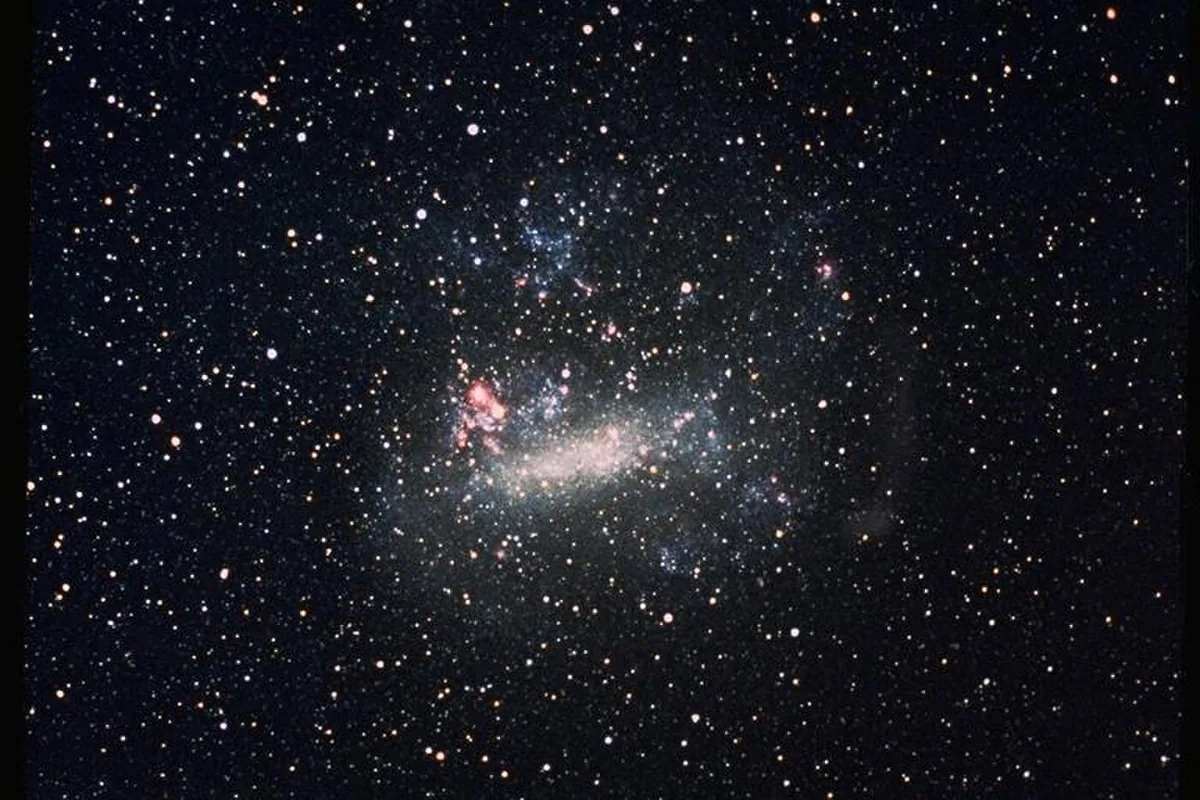
The Large Magellanic Cloud is a satellite galaxy of ours, about 160,000 light-years away, in Dorado and Mensa. From the southern hemisphere it is easily visible to the naked eye as a detached piece of the Milky Way, twenty times as wide as the full Moon.
It is an irregular galaxy about 14,000 light-years across, rich in gas and young stars. It contains the Tarantula Nebula, the largest star nursery in our neighbourhood. In February 1987 the supernova SN 1987A exploded there, the closest seen since the invention of the telescope. Known since time immemorial to the peoples of the southern hemisphere, it bears the name of Magellan, whose expedition described it to Europeans in the 16th century. It cannot be seen from Europe.
2How to find it
Finder chart drawn by CarteDuCiel.eu: the object is circled in orange. North up, east left.
Working it out…
3When to observe it
This object never rises from mid-northern latitudes such as France: you have to travel south of latitude 20° N to see it. In the southern hemisphere it is best placed in the evening in January.
 The Andromeda Galaxy
 The Whirlpool Galaxy
 Bode’s Galaxy
 The Sombrero Galaxy