The Andromeda Galaxy
Spiral galaxy
≈ 2.5 million light-years away, in the constellation Andromeda. Naked eye, under a dark sky.
1Overview
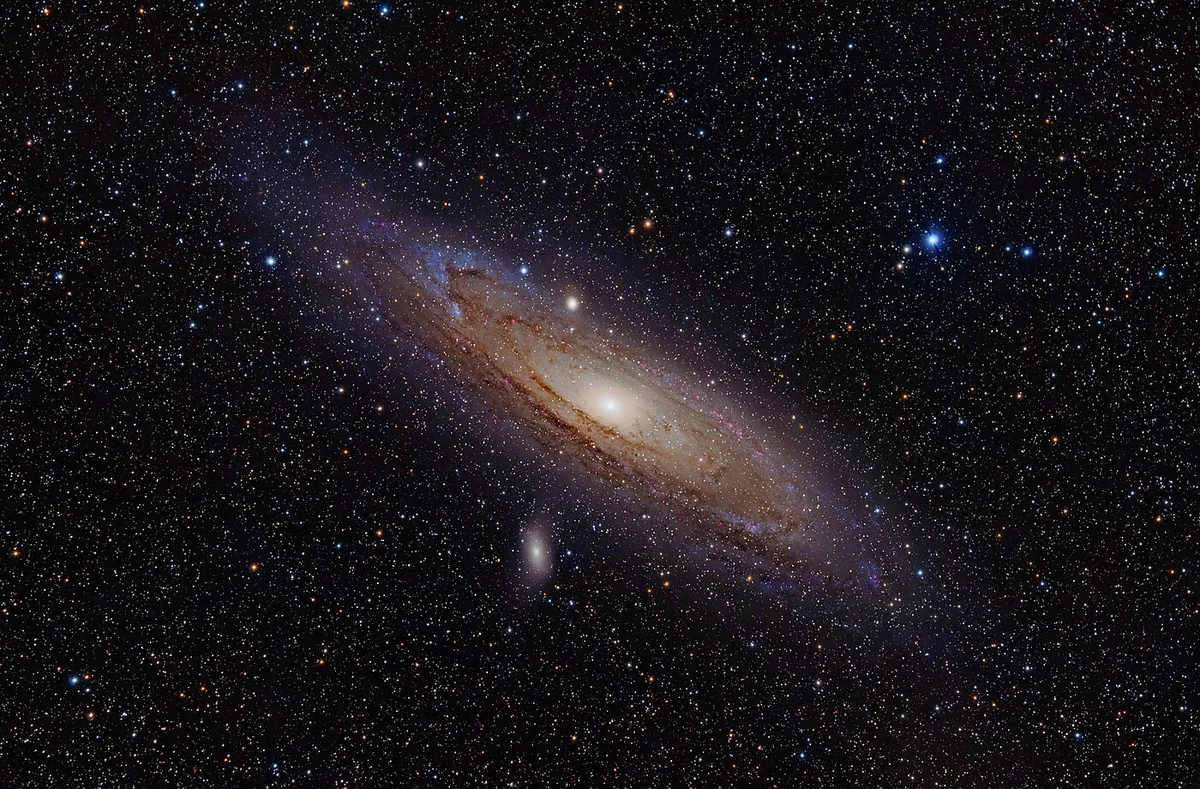
The Andromeda Galaxy (M31) is the nearest large galaxy to ours, about 2.5 million light-years away. Under a dark sky it can be seen with the naked eye as a small elongated smudge: for most of us it is the most distant object visible without an instrument. On a long-exposure photo it stretches across six times the width of the full Moon.
It is a giant spiral, a little larger than the Milky Way, with about a trillion stars and several satellite galaxies, including M32 and M110. In 1923 Edwin Hubble identified Cepheid stars in it and measured its distance: he thereby proved that “spiral nebulae” are other galaxies, far beyond our own.
Andromeda is approaching us at about 110 km/s. The two galaxies could meet and merge in several billion years.
2How to find it
Finder chart drawn by CarteDuCiel.eu: the object is circled in orange. North up, east left.
Working it out…
3When to observe it
From mid-northern latitudes (46° N), the best time to observe it is in the evening in November, when it culminates 85° above the horizon. Choose a moonless night, away from lights.
 The Whirlpool Galaxy
 Bode’s Galaxy
 The Sombrero Galaxy
 The Triangulum Galaxy