Andromeda
Andromeda
Andromeda, a chained princess. A constellation of the northern sky; in the evening it is at its best in October. Its brightest star is Alpheratz.
Working out its position…
1How to find it
Start from the Great Square of Pegasus, the large four-sided figure of medium-bright stars that dominates autumn evenings. Its north-eastern corner, Alpheratz, is actually Andromeda’s head. From there two slightly diverging chains of stars run towards Perseus, like the princess’s outstretched arms.
On the main chain, the second bright star is Mirach. From Mirach, climb two fainter stars towards the north-west: right next to the second one, a small milky smudge shows up under a dark sky. That is the Andromeda Galaxy.
2The main stars
| Star | Name | Magnitude | Distance | Type |
|---|---|---|---|---|
| α Andromedae | Alpheratz | 2.07 | 97 ly | B9 · blue-white |
| β Andromedae | Mirach | 2.07 | 197 ly | M0III · red giant |
| γ¹ Andromedae | Almach | 2.10 | 393 ly | B8V · blue-white, main sequence |
| δ Andromedae | — | 3.27 | 106 ly | K3III · orange giant |
| 51 Andromedae | Nembus | 3.59 | 177 ly | K3III · orange giant |
| ο Andromedae | — | 3.62 | 687 ly | B6 · blue-white |
| λ Andromedae | — | 3.81 (variable 3.7–4.0) | 86 ly | G8III · yellow giant |
| μ Andromedae | — | 3.86 | 130 ly | A5V · white, main sequence |
| ζ Andromedae | — | 4.08 | 189 ly | K1II · orange giant |
| υ Andromedae | Titawin | 4.10 | 44 ly | F8V · yellow-white, main sequence |
The smaller the magnitude, the brighter the star. Distances come from the Hipparcos satellite; beyond a few hundred light-years they are approximate.
3Myth and origin of the name
Andromeda was the daughter of Cepheus and Cassiopeia, rulers of a kingdom the Greeks placed in Ethiopia. Her proud mother once boasted that she was more beautiful than the Nereids, the nymphs of the sea. Offended, they complained to Poseidon, who flooded the coast and sent a sea monster to ravage the land.
An oracle declared that only one thing would calm the god: Andromeda must be given to the monster. The young woman was chained to a rock facing the waves. Perseus, flying home after slaying the Gorgon Medusa, saw her, killed the creature and married her. The whole family now shares the autumn sky: the king, the queen, the princess, her rescuer and even the monster, shown as Cetus.
4History
It is one of the 48 constellations described by Claudius Ptolemy around AD 150 in the Almagest, the great treatise of Greek astronomy that remained the reference for more than a thousand years.
Around 964 the Persian astronomer Abd al-Rahman al-Sufi described a “small cloud” near Andromeda’s girdle in his Book of Fixed Stars: it is the oldest known mention of the galaxy M31. In 1923 the American Edwin Hubble found variable stars in it that proved it lies far beyond our Milky Way.
Its present boundaries were drawn by the Belgian astronomer Eugène Delporte and adopted by the International Astronomical Union in 1930, like those of the other 87 constellations.
5Notable objects
6When to observe it
It is fully visible from every latitude north of 37° S. In the evening around 10 pm, it is highest in the sky in October (seen from mid-northern latitudes).
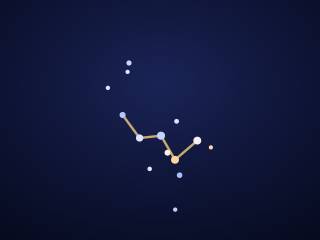 Cassiopeia
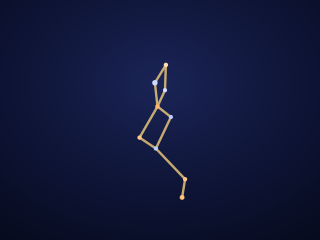 Lacerta
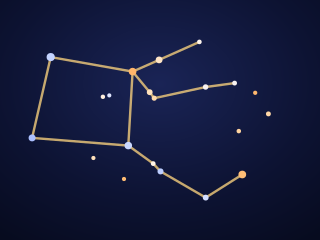 Pegasus
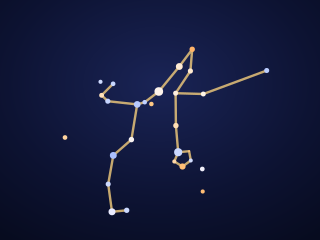 Perseus
 Pisces
 Triangulum