Antlia
Air Pump
Antlia (Air Pump), an air pump. A constellation of the southern sky; in the evening it is at its best in March. Its brightest star is α Antliae.
Working out its position…
1How to find it
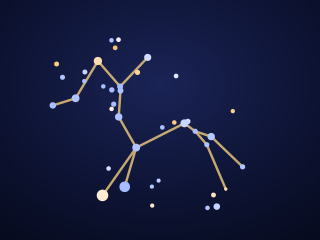
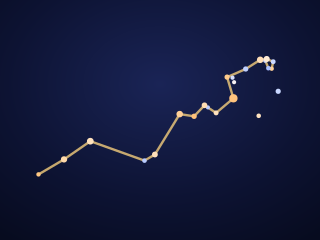
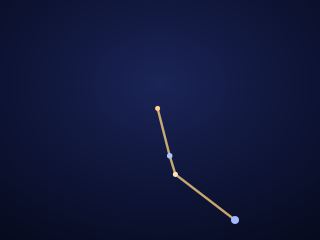
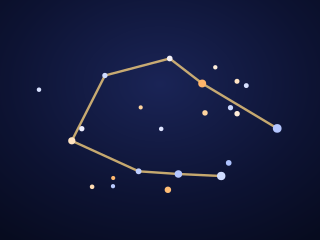
Antlia is a small, very discreet constellation tucked beneath the long body of Hydra, between Pyxis and Vela. Find Alphard, the lonely orange star of Hydra, then move about twenty degrees south: its few stars of magnitude 4 to 5 form an irregular line. From mid-northern latitudes it stays low over the southern horizon on March and April evenings and needs a very clear sky.
2The main stars
| Star | Name | Magnitude | Distance | Type |
|---|---|---|---|---|
| α Antliae | — | 4.28 | 366 ly | K4III · orange giant |
| ε Antliae | — | 4.51 | 711 ly | K3III · orange giant |
| ι Antliae | — | 4.60 | 190 ly | K0III · orange giant |
| θ Antliae | — | 4.78 | 339 ly | A7V · white, main sequence |
| η Antliae | — | 5.23 | 109 ly | A8IV · white subgiant |
| HR 4086 | — | 5.34 | 135 ly | A8V · white, main sequence |
| HR 4313 | — | 5.43 | 518 ly | A0V · white, main sequence |
| HR 3770 | — | 5.49 | 790 ly | K2III · orange giant |
| HR 4153 | — | 5.50 (variable 5.4–5.8) | 874 ly | C · carbon, red |
| HR 4049 | — | 5.52 (variable 5.4–5.6) | 2,652 ly | B9.5Ib · blue-white supergiant |
The smaller the magnitude, the brighter the star. Distances come from the Hipparcos satellite; beyond a few hundred light-years they are approximate.
3Myth and origin of the name
There is no legend behind Antlia: it is a tribute to science. In the 17th century the German Otto von Guericke invented a pump that could remove the air from a container. Robert Boyle, then the Frenchman Denis Papin, improved it and used it to study vacuum, pressure and combustion.
By naming this corner of the southern sky, Lacaille wanted to celebrate the instrument that brought physics into the age of experiment. Its original French name was “la Machine pneumatique”, rendered in Latin as Antlia pneumatica and later shortened to Antlia.
4History
The French astronomer Nicolas-Louis de Lacaille created it after charting nearly 10,000 southern stars from the Cape of Good Hope in 1751 and 1752. Like his thirteen other constellations, it honours an instrument of the sciences or the arts; it appears on his planisphere of 1756.
Its brightest star only reaches magnitude 4.3, and Lacaille gave Greek letters to just a handful of its stars.
Its present boundaries were drawn by the Belgian astronomer Eugène Delporte and adopted by the International Astronomical Union in 1930, like those of the other 87 constellations.
5Notable objects
6When to observe it
It is fully visible from every latitude south of 50° N. In the evening around 10 pm, it is highest in the sky in March (seen from mid-northern latitudes).
 Centaurus
 Hydra
 Pyxis
 Vela