Pyxis
Compass
Pyxis (Compass), a compass. A constellation of the southern sky; in the evening it is at its best in February. Its brightest star is α Pyxidis.
Working out its position…
1How to find it
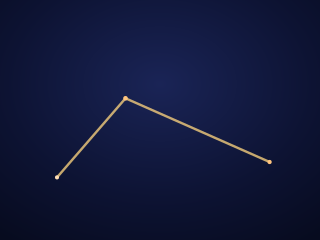
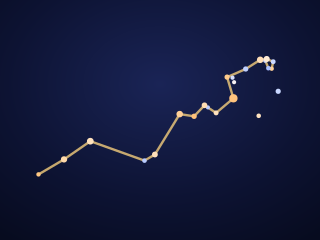
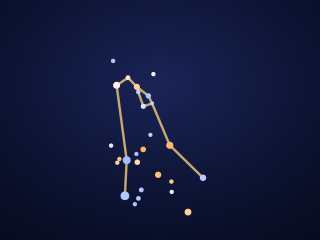
Pyxis is a small, faint constellation east of Puppis and below the head of Hydra. Three stars of magnitude 3.6 to 4 form a short line, like the needle of a compass. From mid-northern latitudes it is low in the south on February and March evenings; look for it halfway between Puppis and Alphard.
2The main stars
| Star | Name | Magnitude | Distance | Type |
|---|---|---|---|---|
| α Pyxidis | — | 3.68 | 879 ly | B1.5III · blue-white giant |
| β Pyxidis | — | 3.97 | 416 ly | G5II · yellow giant |
| γ Pyxidis | — | 4.02 | 207 ly | K3III · orange giant |
| κ Pyxidis | — | 4.62 | 560 ly | K4 · orange giant |
| θ Pyxidis | — | 4.71 | 503 ly | M0III · red giant |
| λ Pyxidis | — | 4.71 | 192 ly | G8III · yellow giant |
| ζ Pyxidis | — | 4.86 | 244 ly | G5III · yellow giant |
| δ Pyxidis | — | 4.87 | 247 ly | A3IV · white subgiant |
| HR 3430 | — | 5.05 | 63 ly | G3 · yellow, main sequence |
| HR 3512 | — | 5.19 | 224 ly | G8III · yellow giant |
The smaller the magnitude, the brighter the star. Distances come from the Hipparcos satellite; beyond a few hundred light-years they are approximate.
3Myth and origin of the name
Lacaille called it “the Compass”, the sailors’ magnetic compass. He placed it close to the ship Argo, as if the navigation instrument stood on the deck. It is an amusing anachronism: the compass obviously did not exist in the days of the Argonauts.
In the 19th century some astronomers suggested renaming it “the Mast” to complete the ship, but it is Lacaille’s compass that has stayed.
4History
The French astronomer Nicolas-Louis de Lacaille created it after charting nearly 10,000 southern stars from the Cape of Good Hope in 1751 and 1752. Like his thirteen other constellations, it honours an instrument of the sciences or the arts; it appears on his planisphere of 1756.
Pyxis contains T Pyxidis, a recurrent nova that flared up in 1890, 1902, 1920, 1944, 1966 and 2011. A white dwarf pulls matter from a neighbouring star until it triggers an explosion on its surface.
Its present boundaries were drawn by the Belgian astronomer Eugène Delporte and adopted by the International Astronomical Union in 1930, like those of the other 87 constellations.
5Notable objects
6When to observe it
It is fully visible from every latitude south of 53° N. In the evening around 10 pm, it is highest in the sky in February (seen from mid-northern latitudes).
 Antlia
 Hydra
 Puppis
 Vela