Puppis
Stern
Puppis (Stern), the back of a ship. A constellation of the southern sky; in the evening it is at its best in February. Its brightest star is Naos.
Working out its position…
1How to find it
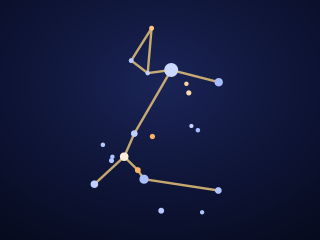
Puppis is the stern of the ship Argo. It stretches south-east of Canis Major, in a very rich part of the winter Milky Way. From mid-northern latitudes its northern part rises low on the southern horizon on February evenings: look below Sirius, east of Adhara and Wezen, for the clusters M46 and M47, visible in binoculars. Its bright star Naos is only well seen from further south.
2The main stars
| Star | Name | Magnitude | Distance | Type |
|---|---|---|---|---|
| ζ Puppis | Naos | 2.21 | 1,084 ly | O5I · blue supergiant |
| π Puppis | — | 2.71 | 807 ly | K3Ib · orange supergiant |
| ρ Puppis | Tureis | 2.83 | 64 ly | F2 · yellow-white giant |
| τ Puppis | — | 2.94 | 182 ly | K0III · orange giant |
| ν Puppis | — | 3.17 | 372 ly | B8III · blue-white giant |
| σ Puppis | — | 3.25 | 194 ly | K5III · orange giant |
| ξ Puppis | Azmidi | 3.34 | 1,199 ly | G6Ia · yellow supergiant |
| HR 3017 | — | 3.62 | 1,132 ly | K4III · orange giant |
| HR 3080 | — | 3.71 | 353 ly | G5III · yellow giant |
| HR 2948 | — | 3.80 | 347 ly | B5IV · blue-white subgiant |
The smaller the magnitude, the brighter the star. Distances come from the Hipparcos satellite; beyond a few hundred light-years they are approximate.
3Myth and origin of the name
Puppis is the rear part of the Argonauts’ ship, where the helmsman stood at the tiller. The ship Argo, built by Argus under Athena’s guidance, carried Jason and some fifty heroes to Colchis in search of the golden fleece.
After Lacaille split the ship, Puppis kept an oddity: the Greek letters of its stars were shared among the three parts of Argo, so it has neither Alpha nor Beta. Its brightest star is called Zeta, or Naos.
4History
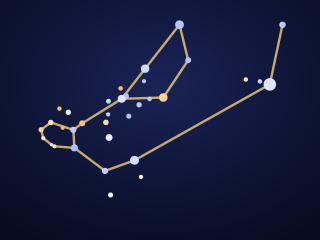
It was once part of Argo, the enormous ship described by Ptolemy. Too large to be practical, Argo was divided by Nicolas-Louis de Lacaille into three constellations, Carina, Puppis and Vela, in his catalogue of southern stars published in 1763.
Naos is one of the hottest and most luminous stars visible to the naked eye: a blue supergiant with a surface hotter than 40,000 degrees. The cluster M46 has a quirk: a planetary nebula, NGC 2438, seems to sit in the middle of it, although it is actually closer to us.
Its present boundaries were drawn by the Belgian astronomer Eugène Delporte and adopted by the International Astronomical Union in 1930, like those of the other 87 constellations.
5Notable objects
6When to observe it
It is fully visible from every latitude south of 39° N. From mid-northern latitudes such as France (46° N), only its northern part rises above the southern horizon; to see all of it you need to be south of latitude 39° N. In the evening around 10 pm, it is highest in the sky in February (seen from mid-northern latitudes).
 Canis Major
 Carina
 Columba
 Hydra
 Monoceros
 Pictor
 Pyxis
 Vela