Carina
Keel
Carina (Keel), the hull of a ship. A constellation of the southern sky; in the evening it is at its best in March. Its brightest star is Canopus.
Working out its position…
1How to find it
Carina belongs to the southern sky: Canopus only rises south of about latitude 37° N (southern Spain, Crete, North Africa, the southern United States). From the southern hemisphere it is found thanks to Canopus, the second brightest star in the sky, lying far south of Sirius. Carina then stretches along the Milky Way to the neighbourhood of the Southern Cross. Beware of the “False Cross”, made of two stars of Carina and two of Vela: larger and fainter than the real Southern Cross, it often fools beginners.
2The main stars
| Star | Name | Magnitude | Distance | Type |
|---|---|---|---|---|
| α Carinae | Canopus | -0.62 | 309 ly | F0Ib · yellow-white supergiant |
| β Carinae | Miaplacidus | 1.67 | 113 ly | A2IV · white subgiant |
| ε Carinae | Avior | 1.86 | 605 ly | K3III · orange giant |
| ι Carinae | Aspidiske | 2.21 | 766 ly | A8Ib · white supergiant |
| θ Carinae | — | 2.74 | 456 ly | B0V · blue-white, main sequence |
| υ Carinae | — | 2.92 | 1,437 ly | A9 · white |
| ω Carinae | — | 3.29 | 342 ly | B8III · blue-white giant |
| HR 4140 | — | 3.30 (variable 3.2–3.4) | 483 ly | B4V · blue-white, main sequence |
| HR 4050 | — | 3.39 | 658 ly | K3II · orange giant |
| HR 3659 | — | 3.43 | 447 ly | B2IV · blue-white subgiant |
The smaller the magnitude, the brighter the star. Distances come from the Hipparcos satellite; beyond a few hundred light-years they are approximate.
3Myth and origin of the name
Carina is the hull of the ship Argo, on which Jason and the Argonauts set out to find the golden fleece. The ship, built with the help of the goddess Athena, had a prow carved from a sacred, talking oak. After the adventure it was placed in the southern sky, where it seems to sail along the Milky Way.
The star Canopus is named after a character from the Trojan War: the helmsman of Menelaus’s ship, who died in Egypt near the city that was named Canopus in his honour.
4History
It was once part of Argo, the enormous ship described by Ptolemy. Too large to be practical, Argo was divided by Nicolas-Louis de Lacaille into three constellations, Carina, Puppis and Vela, in his catalogue of southern stars published in 1763.
In 1843 the star Eta Carinae, wrapped in a nebula, underwent a “Great Eruption” that briefly made it the second brightest star in the sky; it then surrounded itself with an hourglass-shaped cloud, the Homunculus. Canopus, for its part, has served since the 1960s as a reference star for space probes finding their bearings.
Its present boundaries were drawn by the Belgian astronomer Eugène Delporte and adopted by the International Astronomical Union in 1930, like those of the other 87 constellations.
5Notable objects
6When to observe it
It is fully visible from every latitude south of 14° N. It is never visible from mid-northern latitudes such as France (46° N): you have to travel south of about 14° N to see all of it. In the evening around 10 pm, it is highest in the sky in March (seen from mid-southern latitudes).
 Centaurus
 Chamaeleon
 Musca
 Pictor
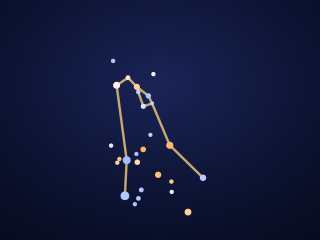 Puppis
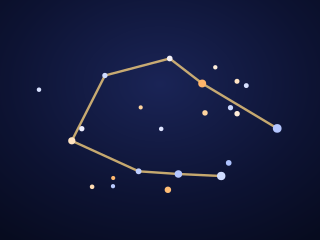 Vela
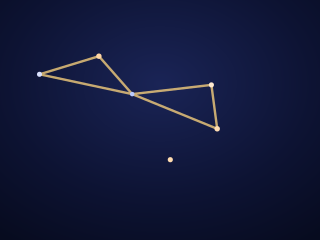 Volans