Capricornus
Sea Goat
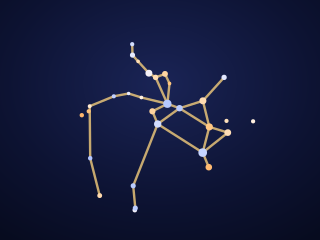
Capricornus (Sea Goat), a goat with a fish tail. A constellation of the southern sky; in the evening it is at its best in September. Its brightest star is Deneb Algedi.
Working out its position…
1How to find it
Capricornus is recognised by its large triangle with curved sides, sometimes likened to a smile or a boat. It lies east of Sagittarius and south-west of Aquarius, low in the south on late-summer and autumn evenings from mid-northern latitudes. At the western tip of the triangle, look at Algedi: to the naked eye, under a dark sky, it shows as two very close stars, which are not actually linked.
2The main stars
| Star | Name | Magnitude | Distance | Type |
|---|---|---|---|---|
| δ Capricorni | Deneb Algedi | 2.85 | 39 ly | A5 · white subgiant |
| β Capricorni | Dabih | 3.05 | 327 ly | A5 · white |
| α² Capricorni | Algedi | 3.58 | 106 ly | G6 · yellow giant |
| γ Capricorni | Nashira | 3.69 | 157 ly | A7III · white giant |
| ζ Capricorni | — | 3.77 | 386 ly | G4Ib · yellow supergiant |
| θ Capricorni | — | 4.08 | 162 ly | A1V · white, main sequence |
| ω Capricorni | — | 4.12 | 843 ly | K4III · orange giant |
| ψ Capricorni | — | 4.13 | 48 ly | F5V · yellow-white, main sequence |
| ι Capricorni | — | 4.28 | 197 ly | G8III · yellow giant |
| α¹ Capricorni | — | 4.30 | 569 ly | G3Ib · yellow supergiant |
The smaller the magnitude, the brighter the star. Distances come from the Hipparcos satellite; beyond a few hundred light-years they are approximate.
3Myth and origin of the name
Capricornus is one of the oldest figures in the sky. The Babylonians already saw a “goat-fish” here, the animal of the god Ea, lord of fresh water and wisdom. The Greeks kept this strange creature, half goat and half fish.
For them it was Pan, the god of shepherds. When the monster Typhon attacked the gods, they all fled by changing shape. Pan leapt into the Nile: the part of his body under the water turned into a fish, while the part above stayed a goat. Others saw the goat Amalthea, nurse of the infant Zeus.
4History
It is one of the 48 constellations described by Claudius Ptolemy around AD 150 in the Almagest, the great treatise of Greek astronomy that remained the reference for more than a thousand years.
Two thousand years ago the Sun stood here at the December solstice: hence the name “Tropic of Capricorn” for the latitude where it is then overhead. Today, because of precession, that solstice occurs in Sagittarius.
Its present boundaries were drawn by the Belgian astronomer Eugène Delporte and adopted by the International Astronomical Union in 1930, like those of the other 87 constellations.
5Notable objects
6When to observe it
It is fully visible from every latitude south of 62° N. In the evening around 10 pm, it is highest in the sky in September (seen from mid-northern latitudes).
 Aquila
 Aquarius
 Microscopium
 Piscis Austrinus
 Sagittarius