Microscopium
Microscope
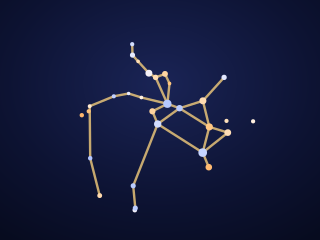
Microscopium (Microscope), a microscope. A constellation of the southern sky; in the evening it is at its best in September. Its brightest star is γ Microscopii.
Working out its position…
1How to find it
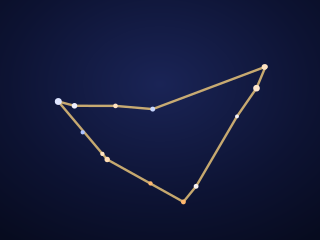
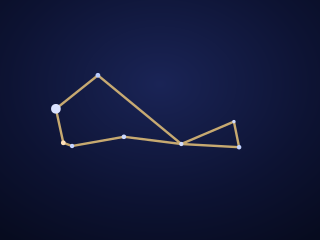
Microscopium is a small, faint constellation south of Capricornus and west of Piscis Austrinus. Its stars, all fainter than magnitude 4.6, outline a small rectangle. From mid-northern latitudes it appears very low in the south on September evenings; you need an open horizon and a really dark sky.
2The main stars
| Star | Name | Magnitude | Distance | Type |
|---|---|---|---|---|
| γ Microscopii | — | 4.67 | 229 ly | G8III · yellow giant |
| ε Microscopii | — | 4.71 | 182 ly | A0V · white, main sequence |
| θ¹ Microscopii | — | 4.80 | 197 ly | A2 · white |
| α Microscopii | — | 4.89 | 378 ly | G8III · yellow giant |
| ι Microscopii | — | 5.11 | 116 ly | F1IV · yellow-white subgiant |
| ν Microscopii | — | 5.12 | 234 ly | K0III · orange giant |
| HR 8076 | — | 5.20 | 328 ly | K2III · orange giant |
| HR 8104 | — | 5.25 | 108 ly | F5V · yellow-white, main sequence |
| ζ Microscopii | — | 5.32 | 115 ly | F3V · yellow-white, main sequence |
| HR 7987 | — | 5.34 | 400 ly | K2III · orange giant |
The smaller the magnitude, the brighter the star. Distances come from the Hipparcos satellite; beyond a few hundred light-years they are approximate.
3Myth and origin of the name
Lacaille placed a compound microscope in the sky, the instrument that revealed an invisible world in the 17th century: cells, microbes, the structure of insects. The Dutchman Antoni van Leeuwenhoek and the Englishman Robert Hooke had turned these observations into a real scientific adventure.
It is fun to find this instrument of the very small next to Telescopium, another of Lacaille’s creations devoted to the very large: two ways of seeing what the eye alone cannot see.
4History
The French astronomer Nicolas-Louis de Lacaille created it after charting nearly 10,000 southern stars from the Cape of Good Hope in 1751 and 1752. Like his thirteen other constellations, it honours an instrument of the sciences or the arts; it appears on his planisphere of 1756.
The star AU Microscopii, a young red dwarf 32 light-years away, is surrounded by a disc of dust in which planets are forming; two of them have been discovered since 2020.
Its present boundaries were drawn by the Belgian astronomer Eugène Delporte and adopted by the International Astronomical Union in 1930, like those of the other 87 constellations.
5Notable objects
6When to observe it
It is fully visible from every latitude south of 45° N. From mid-northern latitudes such as France (46° N), only its northern part rises above the southern horizon; to see all of it you need to be south of latitude 45° N. In the evening around 10 pm, it is highest in the sky in September (seen from mid-northern latitudes).
 Capricornus
 Grus
 Indus
 Piscis Austrinus
 Sagittarius