Sagittarius
Archer
Sagittarius (Archer), a centaur archer. A constellation of the southern sky; in the evening it is at its best in August. Its brightest star is Kaus Australis.
Working out its position…
1How to find it
Sagittarius is recognised by its “Teapot”: eight bright stars drawing a teapot with its lid, its handle on the left and its spout on the right. On summer evenings look for it very low in the south, east (left) of the tail of Scorpius. Under a dark sky the Milky Way seems to rise from the spout like steam: that is where the centre of our galaxy lies.
2The main stars
| Star | Name | Magnitude | Distance | Type |
|---|---|---|---|---|
| ε Sagittarii | Kaus Australis | 1.79 | 143 ly | B9.5III · blue-white giant |
| σ Sagittarii | Nunki | 2.05 | 228 ly | B2.5V · blue-white, main sequence |
| ζ Sagittarii | Ascella | 2.60 | 88 ly | A3IV · white subgiant |
| δ Sagittarii | Kaus Media | 2.72 | 348 ly | K3III · orange giant |
| λ Sagittarii | Kaus Borealis | 2.82 | 78 ly | K1III · orange supergiant |
| π Sagittarii | Albaldah | 2.88 | 510 ly | F2II · yellow-white giant |
| γ² Sagittarii | Alnasl | 2.98 | 97 ly | K0III · orange giant |
| η Sagittarii | — | 3.10 | 146 ly | M2III · red giant |
| φ Sagittarii | — | 3.17 | 239 ly | B8.5III · blue-white giant |
| τ Sagittarii | — | 3.32 | 122 ly | K1 · orange giant |
The smaller the magnitude, the brighter the star. Distances come from the Hipparcos satellite; beyond a few hundred light-years they are approximate.
3Myth and origin of the name
Sagittarius is an archer, often shown as a centaur drawing his bow. His arrow aims at Antares, the heart of the neighbouring Scorpion, as if to avenge Orion. For some Greeks he was Crotus, son of Pan and of the Muses’ nurse, inventor of archery and a great hunter, whom the Muses had placed among the stars.
The archer figure is much older than the Greeks: the Babylonians already drew here a winged archer god, part human and part animal, with two heads.
4History
It is one of the 48 constellations described by Claudius Ptolemy around AD 150 in the Almagest, the great treatise of Greek astronomy that remained the reference for more than a thousand years.
In the direction of Sagittarius, about 26,000 light-years away, lies the centre of the Milky Way and its giant black hole, Sagittarius A*, four million times as massive as the Sun; its first image was published in 2022. The December solstice now occurs when the Sun is in Sagittarius. The constellation is packed with famous objects: the Lagoon, Trifid and Omega nebulae, the cluster M22, and M54, a cluster that actually belongs to a small neighbouring galaxy being swallowed by ours.
Its present boundaries were drawn by the Belgian astronomer Eugène Delporte and adopted by the International Astronomical Union in 1930, like those of the other 87 constellations.
5Notable objects
6When to observe it
It is fully visible from every latitude south of 45° N. From mid-northern latitudes such as France (46° N), only its northern part rises above the southern horizon; to see all of it you need to be south of latitude 45° N. In the evening around 10 pm, it is highest in the sky in August (seen from mid-northern latitudes).
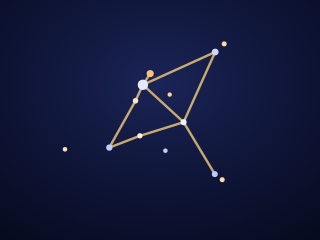 Aquila
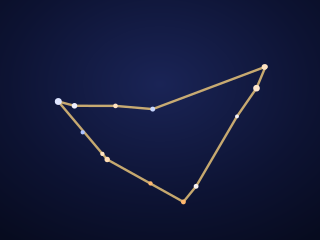 Capricornus
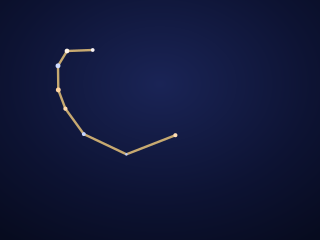 Corona Australis
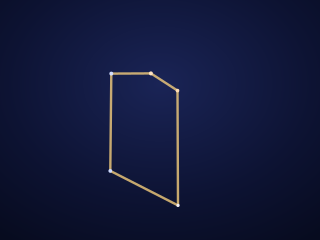 Microscopium
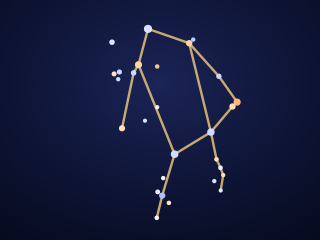 Ophiuchus
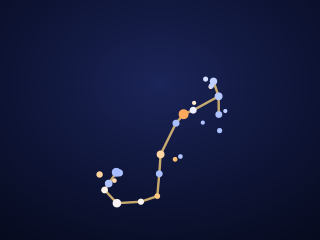 Scorpius
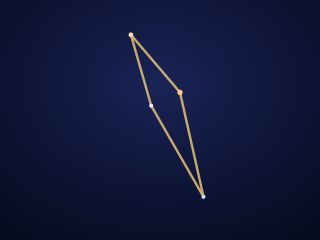 Scutum
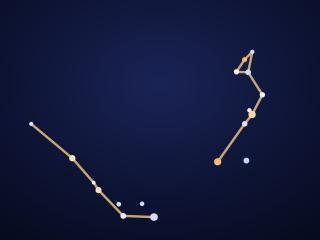 Serpens
 Telescopium