Scorpius
Scorpion
Scorpius (Scorpion), a scorpion. A constellation of the southern sky; in the evening it is at its best in July. Its brightest star is Antares.
Working out its position…
1How to find it
Scorpius is one of the few constellations that really look like their name. In the centre shines Antares, a supergiant of an intense orange-red, the creature’s heart. To the right, a curved line of three stars forms the head and claws; to the left and below, a long hooked tail ends with the sting, Shaula and Lesath. From mid-northern latitudes it is low in the south in June and July, and its tail skims the horizon: an open horizon is essential.
2The main stars
| Star | Name | Magnitude | Distance | Type |
|---|---|---|---|---|
| α Scorpii | Antares | 1.06 | 554 ly | M1Ib · red supergiant |
| λ Scorpii | Shaula | 1.62 | 571 ly | B1.5IV · blue-white subgiant |
| θ Scorpii | Sargas | 1.86 | 300 ly | F1II · yellow-white giant |
| δ Scorpii | Dschubba | 2.29 | 491 ly | B0.2IV · blue-white subgiant |
| ε Scorpii | Larawag | 2.29 | 64 ly | K2III · orange supergiant |
| κ Scorpii | — | 2.39 | 483 ly | B1.5III · blue-white giant |
| β¹ Scorpii | Acrab | 2.56 | 404 ly | B0.5V · blue-white, main sequence |
| υ Scorpii | Lesath | 2.70 | 576 ly | B2IV · blue-white subgiant |
| τ Scorpii | Paikauhale | 2.82 | 474 ly | B0V · blue-white, main sequence |
| π Scorpii | Fang | 2.89 | 586 ly | B1V · blue-white, main sequence |
The smaller the magnitude, the brighter the star. Distances come from the Hipparcos satellite; beyond a few hundred light-years they are approximate.
3Myth and origin of the name
It is the scorpion sent by Gaia, the Earth, to punish the arrogant hunter Orion, who threatened to kill every animal. The scorpion stung Orion on the heel. The gods placed the two enemies at opposite ends of the sky so they would never meet: when Scorpius rises, Orion sets.
Scorpius also appears in the story of Phaethon: it was on seeing the monster raise its sting that the horses of the Sun panicked and the young driver lost control of the chariot. The name Antares means “rival of Ares”, the god the Romans called Mars, because it rivals the red planet in colour.
4History
It is one of the 48 constellations described by Claudius Ptolemy around AD 150 in the Almagest, the great treatise of Greek astronomy that remained the reference for more than a thousand years.
The cluster M7, next to the sting, was mentioned by Ptolemy around AD 130 as a nebulous patch. In 1962 a rocket carrying a detector designed by Riccardo Giacconi’s team discovered in Scorpius the first X-ray source outside the Solar System, Scorpius X-1, opening up a new kind of astronomy. The globular cluster M4, close to Antares, is one of the nearest to us.
Its present boundaries were drawn by the Belgian astronomer Eugène Delporte and adopted by the International Astronomical Union in 1930, like those of the other 87 constellations.
5Notable objects
6When to observe it
It is fully visible from every latitude south of 44° N. From mid-northern latitudes such as France (46° N), only its northern part rises above the southern horizon; to see all of it you need to be south of latitude 44° N. In the evening around 10 pm, it is highest in the sky in July (seen from mid-northern latitudes).
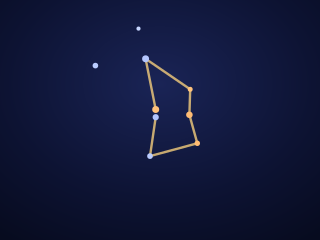 Ara
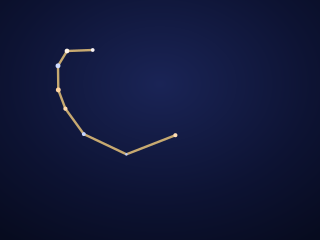 Corona Australis
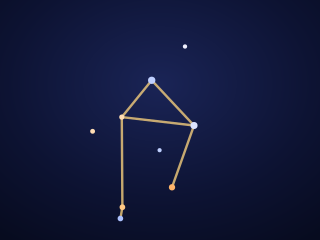 Libra
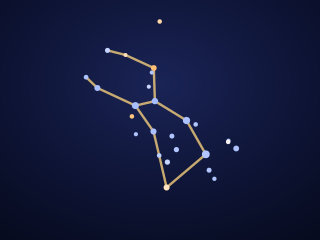 Lupus
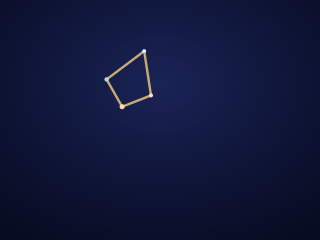 Norma
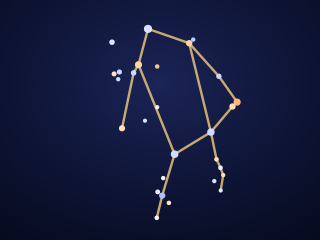 Ophiuchus
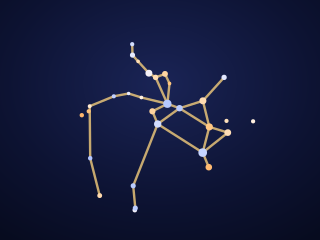 Sagittarius