Ara
Altar
Ara (Altar), an altar. A constellation of the southern sky; in the evening it is at its best in July. Its brightest star is β Arae.
Working out its position…
1How to find it
Ara lies in the southern sky, just south of the tail of Scorpius, set in a rich part of the Milky Way. From the southern hemisphere, find the Scorpion’s sting (Shaula and Lesath), then move about fifteen degrees towards the pole: a trapezium of magnitude 3 stars forms the altar table. It cannot be seen from most of Europe; it starts to graze the horizon at the latitude of North Africa.
2The main stars
| Star | Name | Magnitude | Distance | Type |
|---|---|---|---|---|
| β Arae | — | 2.84 | 646 ly | K3Ib · orange supergiant |
| α Arae | — | 2.84 | 267 ly | B2V · blue-white, main sequence |
| ζ Arae | — | 3.12 | 486 ly | K5III · orange giant |
| γ Arae | — | 3.31 | 1,113 ly | B1Ib · blue-white supergiant |
| δ Arae | — | 3.60 | 198 ly | B8V · blue-white, main sequence |
| θ Arae | — | 3.65 | 813 ly | B2Ib · blue-white supergiant |
| η Arae | — | 3.77 | 299 ly | K5III · orange giant |
| ε¹ Arae | — | 4.06 | 361 ly | K4III · orange giant |
| σ Arae | — | 4.56 | 378 ly | A0V · white, main sequence |
| λ Arae | — | 4.76 | 70 ly | F3IV · yellow-white subgiant |
The smaller the magnitude, the brighter the star. Distances come from the Hipparcos satellite; beyond a few hundred light-years they are approximate.
3Myth and origin of the name
According to the Greeks, it was on this altar that Zeus and the gods of Olympus swore an oath before fighting the Titans, their elders, for control of the world. The Cyclopes were said to have built it for the occasion. After the victory Zeus set it in the sky to remind people of the value of oaths.
The Milky Way passing just above it was sometimes described as the smoke rising from the offerings burnt on the altar. In old atlases the flame is drawn pointing south, since the figure was imagined by Greek observers who saw it grazing their horizon.
4History
It is one of the 48 constellations described by Claudius Ptolemy around AD 150 in the Almagest, the great treatise of Greek astronomy that remained the reference for more than a thousand years.
For Ptolemy, observing from Alexandria, Ara was a very low constellation; its southernmost stars were barely visible.
Its present boundaries were drawn by the Belgian astronomer Eugène Delporte and adopted by the International Astronomical Union in 1930, like those of the other 87 constellations.
5Notable objects
6When to observe it
It is fully visible from every latitude south of 22° N. It is never visible from mid-northern latitudes such as France (46° N): you have to travel south of about 22° N to see all of it. In the evening around 10 pm, it is highest in the sky in July (seen from mid-southern latitudes).
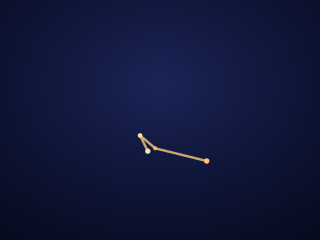 Apus
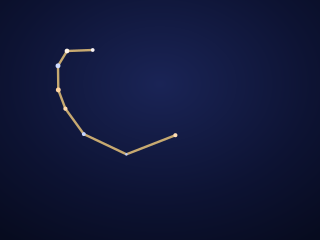 Corona Australis
 Norma
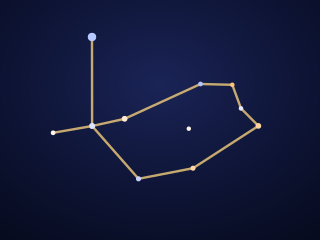 Pavo
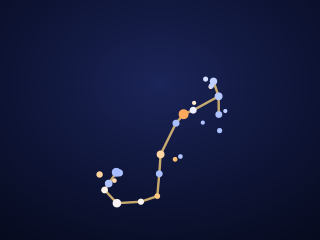 Scorpius
 Telescopium
 Triangulum Australe