Corona Australis
Southern Crown
Corona Australis (Southern Crown), a crown. A constellation of the southern sky; in the evening it is at its best in August. Its brightest star is β Coronae Australis.
Working out its position…
1How to find it
Corona Australis is a small semicircular arc of magnitude 4 to 5 stars, set just south of the Teapot of Sagittarius. From mid-northern latitudes it skims the southern horizon on July evenings; you see it well only with a perfectly clear horizon, or better still from southern Europe or the southern hemisphere.
2The main stars
| Star | Name | Magnitude | Distance | Type |
|---|---|---|---|---|
| β Coronae Australis | — | 4.10 | 474 ly | K0II · orange giant |
| α Coronae Australis | Meridiana | 4.11 | 125 ly | A0 · white, main sequence |
| γ Coronae Australis | — | 4.23 | 56 ly | F7IV · yellow-white subgiant |
| δ Coronae Australis | — | 4.57 | 178 ly | K1III · orange giant |
| θ Coronae Australis | — | 4.62 | 558 ly | G5III · yellow giant |
| ζ Coronae Australis | — | 4.74 | 193 ly | A0V · white, main sequence |
| ε Coronae Australis | — | 4.83 (variable 4.7–5.0) | 98 ly | F3IV · yellow-white subgiant |
| HR 6749 | — | 4.92 | 136 ly | A5V · white, main sequence |
| γ Coronae Australis | — | 5.00 | 58 ly | F8V · yellow-white, main sequence |
| HR 6862 | — | 5.09 | 485 ly | K4 · orange giant |
The smaller the magnitude, the brighter the star. Distances come from the Hipparcos satellite; beyond a few hundred light-years they are approximate.
3Myth and origin of the name
The Greeks saw these stars as a crown, or rather a wreath of leaves, fallen at the feet of Sagittarius. It was sometimes linked to Dionysus: the god went down to the underworld to fetch his mother, Semele, who had died before he was born, brought her among the immortals and set a wreath in the sky to celebrate her return.
Others pictured it as a crown dropped by the centaur, or as a glowing wheel. Its northern twin, Corona Borealis, is far better known, but the southern one is no less elegant.
4History
It is one of the 48 constellations described by Claudius Ptolemy around AD 150 in the Almagest, the great treatise of Greek astronomy that remained the reference for more than a thousand years.
It contains one of the star nurseries closest to the Sun, around the variable star R Coronae Australis, about 430 light-years away: bluish nebulae and dark clouds where young stars are forming.
Its present boundaries were drawn by the Belgian astronomer Eugène Delporte and adopted by the International Astronomical Union in 1930, like those of the other 87 constellations.
5Notable objects
6When to observe it
It is fully visible from every latitude south of 44° N. From mid-northern latitudes such as France (46° N), only its northern part rises above the southern horizon; to see all of it you need to be south of latitude 44° N. In the evening around 10 pm, it is highest in the sky in August (seen from mid-northern latitudes).
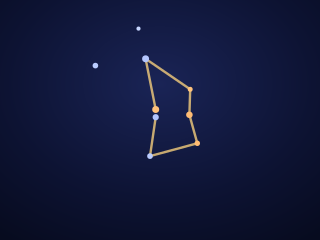 Ara
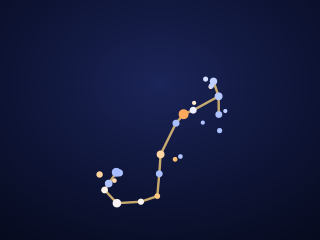 Scorpius
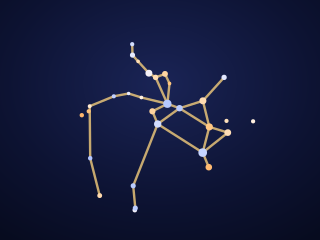 Sagittarius
 Telescopium