Telescopium
Telescope
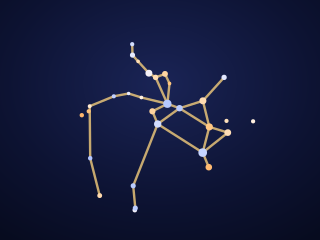
Telescopium (Telescope), a telescope. A constellation of the southern sky; in the evening it is at its best in July. Its brightest star is α Telescopii.
Working out its position…
1How to find it
Telescopium is a faint constellation of the southern sky, below Corona Australis and Sagittarius, north of Pavo. Its brightest star, Alpha, is magnitude 3.5. From mid-northern latitudes it practically never rises; from the southern hemisphere it is easy to find by dropping from the Teapot of Sagittarius towards Pavo.
2The main stars
| Star | Name | Magnitude | Distance | Type |
|---|---|---|---|---|
| α Telescopii | — | 3.49 | 278 ly | B3IV · blue-white subgiant |
| ζ Telescopii | — | 4.10 | 126 ly | G8 · yellow giant |
| ε Telescopii | — | 4.52 | 418 ly | G5III · yellow giant |
| λ Telescopii | — | 4.85 | 612 ly | A0V · white, main sequence |
| ι Telescopii | — | 4.88 | 371 ly | G9III · yellow giant |
| δ¹ Telescopii | — | 4.92 | 708 ly | B6IV · blue-white subgiant |
| ξ Telescopii | — | 4.93 | 1,080 ly | M1II · red giant |
| η Telescopii | — | 5.03 | 157 ly | A0V · white, main sequence |
| δ² Telescopii | — | 5.07 | 1,195 ly | B3III · blue-white giant |
| ρ Telescopii | — | 5.17 | 185 ly | F7V · yellow-white, main sequence |
The smaller the magnitude, the brighter the star. Distances come from the Hipparcos satellite; beyond a few hundred light-years they are approximate.
3Myth and origin of the name
Lacaille placed here an “aerial” telescope, a very long, tubeless model whose lens was hoisted to the top of a mast and aimed with ropes. These giant instruments, used in the 17th century by Christiaan Huygens and Giovanni Domenico Cassini, gave high magnifications.
To draw this telescope, Lacaille borrowed stars from several neighbouring constellations. They were later given back, so today’s Telescopium is smaller and fainter than Lacaille’s.
4History
The French astronomer Nicolas-Louis de Lacaille created it after charting nearly 10,000 southern stars from the Cape of Good Hope in 1751 and 1752. Like his thirteen other constellations, it honours an instrument of the sciences or the arts; it appears on his planisphere of 1756.
It contains the globular cluster NGC 6584 and many distant galaxies, but no object that is easy to see with the naked eye.
Its present boundaries were drawn by the Belgian astronomer Eugène Delporte and adopted by the International Astronomical Union in 1930, like those of the other 87 constellations.
5Notable objects
6When to observe it
It is fully visible from every latitude south of 33° N. It is never visible from mid-northern latitudes such as France (46° N): you have to travel south of about 33° N to see all of it. In the evening around 10 pm, it is highest in the sky in July (seen from mid-southern latitudes).
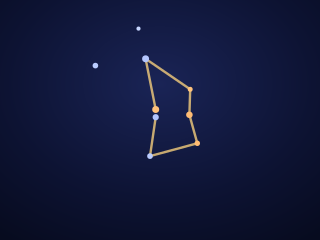 Ara
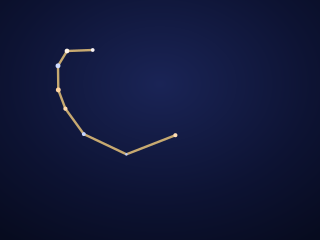 Corona Australis
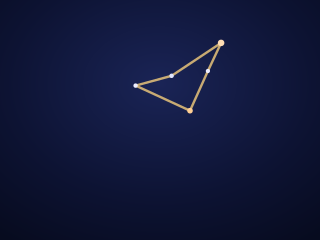 Indus
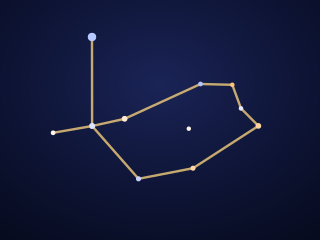 Pavo
 Sagittarius