Taurus
Bull
Taurus (Bull), a bull. A constellation of the northern sky; in the evening it is at its best in December. Its brightest star is Aldebaran.
Working out its position…
1How to find it
To find Taurus, extend the line of the three stars of Orion’s Belt up and to the right (towards the north-west): you reach Aldebaran, the bull’s orange-red eye. Aldebaran seems to sit at the end of a small V of stars, the Hyades cluster, which forms the head. Carrying on in the same direction, you come to the Pleiades, a little bunch of bluish stars on the animal’s shoulder. The horns run from the V towards Elnath and Zeta. Taurus rules the evenings of December and January.
2The main stars
| Star | Name | Magnitude | Distance | Type |
|---|---|---|---|---|
| α Tauri | Aldebaran | 0.87 | 67 ly | K5III · orange giant |
| β Tauri | Elnath | 1.65 | 134 ly | B7III · blue-white giant |
| η Tauri | Alcyone | 2.85 | 403 ly | B7III · blue-white giant |
| ζ Tauri | Tianguan | 2.97 | 445 ly | B4III · blue-white giant |
| θ² Tauri | Chamukuy | 3.40 | 150 ly | A7III · white giant |
| λ Tauri | — | 3.41 | 484 ly | B3V · blue-white, main sequence |
| ε Tauri | Ain | 3.53 | 147 ly | K0III · orange giant |
| ο Tauri | — | 3.61 | 291 ly | G8III · yellow giant |
| 27 Tauri | Atlas | 3.62 | 382 ly | B8III · blue-white giant |
| γ Tauri | Prima Hyadum | 3.65 | 162 ly | G8III · yellow giant |
The smaller the magnitude, the brighter the star. Distances come from the Hipparcos satellite; beyond a few hundred light-years they are approximate.
3Myth and origin of the name
Zeus fell in love with Europa, a Phoenician princess playing on the beach. He took the form of a magnificent white bull, so gentle that Europa dared to climb on its back. At once the animal plunged into the sea and swam to Crete, where Europa became queen. The continent of Europe bears her name. In the sky we only see the front of the bull, as if it were rising out of the waves.
The Hyades and the Pleiades are two groups of sisters, daughters of the Titan Atlas. The Hyades wept so much for the death of their brother Hyas that they were placed in the sky, where their rising heralded the rainy season. The Pleiades, chased by Orion, were turned into doves and then into stars.
4History
It is one of the 48 constellations described by Claudius Ptolemy around AD 150 in the Almagest, the great treatise of Greek astronomy that remained the reference for more than a thousand years.
On 4 July 1054 Chinese astronomers recorded a “guest star” near the southern horn of Taurus, visible in broad daylight for 23 days. It was a supernova, whose remnant is the Crab Nebula; at its heart spins a pulsar, discovered in 1968, turning 30 times a second. In 1758 Charles Messier mistook this cloud for a comet: it was to avoid such confusion that he began his famous catalogue, in which the Crab is number 1.
Its present boundaries were drawn by the Belgian astronomer Eugène Delporte and adopted by the International Astronomical Union in 1930, like those of the other 87 constellations.
5Notable objects
6When to observe it
It is fully visible between latitudes 89° N and 59° S. In the evening around 10 pm, it is highest in the sky in December (seen from mid-northern latitudes).
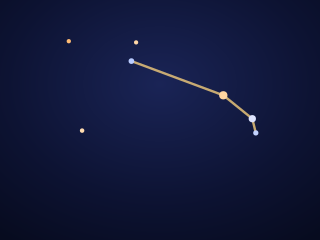 Aries
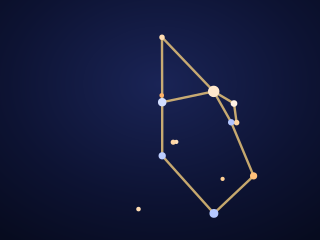 Auriga
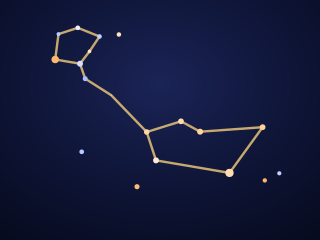 Cetus
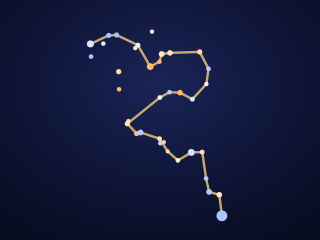 Eridanus
 Gemini
 Orion
 Perseus