Orion
Orion
Orion, a hunter. A constellation near the celestial equator, visible from both hemispheres; in the evening it is at its best in January. Its brightest star is Rigel.
Working out its position…
1How to find it
Orion is the easiest constellation to recognise in the winter sky. Look for three bright stars in a perfectly straight, evenly spaced line: Orion’s Belt. Above it, two stars mark the shoulders: orange Betelgeuse on the left, and Bellatrix. Below it, two more mark the knees: blue-white Rigel on the right, and Saiph. Below the Belt hangs the Sword, where a small fuzzy patch shines: the great Orion Nebula.
Because the Belt lies on the celestial equator, Orion can be seen from all over the Earth. At mid-northern latitudes it is visible in the evening from November to March, in the south.
2The main stars
| Star | Name | Magnitude | Distance | Type |
|---|---|---|---|---|
| β Orionis | Rigel | 0.18 | 863 ly | B8Ia · blue-white supergiant |
| α Orionis | Betelgeuse | 0.45 (variable 0.3–0.6) | 498 ly | M2Ib · red supergiant |
| γ Orionis | Bellatrix | 1.64 | 252 ly | B2III · blue-white giant |
| ε Orionis | Alnilam | 1.69 | 1,977 ly | B0Ia · blue-white supergiant |
| ζ Orionis | Alnitak | 1.74 | 736 ly | O9.5Ib · blue supergiant |
| κ Orionis | Saiph | 2.07 | 647 ly | B0.5Ia · blue-white supergiant |
| δ Orionis | Mintaka | 2.25 | 692 ly | O9.5II · blue giant |
| ι Orionis | Hatysa | 2.75 | 2,330 ly | O9III · blue giant |
| π³ Orionis | Tabit | 3.19 | 26 ly | F6V · yellow-white, main sequence |
| η Orionis | — | 3.35 (variable 3.3–3.6) | 976 ly | B1V · blue-white, main sequence |
The smaller the magnitude, the brighter the star. Distances come from the Hipparcos satellite; beyond a few hundred light-years they are approximate.
3Myth and origin of the name
Orion was a giant hunter, son of Poseidon, of exceptional strength and beauty. Several stories tell of his death. In the most famous, he boasted that he could kill every animal on Earth. Gaia, Mother Earth, sent a scorpion that stung him on the heel. The two enemies were placed at opposite ends of the sky: when Scorpius rises in the east, Orion sets in the west, as if still fleeing.
In another version, the huntress goddess Artemis, who loved him, killed him by mistake: her jealous brother Apollo dared her to hit a distant point in the sea, which was none other than Orion’s head as he swam. Heartbroken, she placed him among the stars with his dogs.
4History
It is one of the 48 constellations described by Claudius Ptolemy around AD 150 in the Almagest, the great treatise of Greek astronomy that remained the reference for more than a thousand years.
In 1610 Nicolas-Claude Fabri de Peiresc, from Provence, was the first to describe the Orion Nebula through a telescope; it is a star nursery about 1,350 light-years away. In 1888 Williamina Fleming spotted the famous Horsehead Nebula on a Harvard photographic plate. Betelgeuse, a variable red supergiant, went through a “Great Dimming” in late 2019 and early 2020 caused by a cloud of dust: it will one day end as a supernova, but perhaps not for tens of thousands of years.
Its present boundaries were drawn by the Belgian astronomer Eugène Delporte and adopted by the International Astronomical Union in 1930, like those of the other 87 constellations.
5Notable objects
6When to observe it
It is fully visible between latitudes 79° N and 67° S. In the evening around 10 pm, it is highest in the sky in January (seen from mid-northern latitudes).
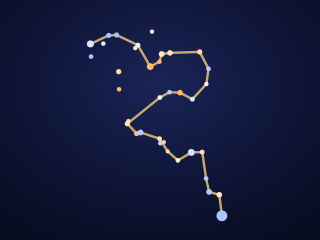 Eridanus
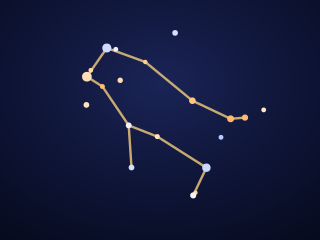 Gemini
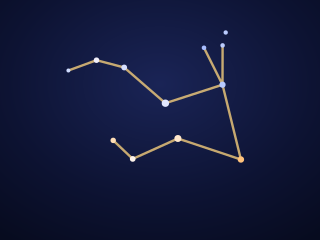 Lepus
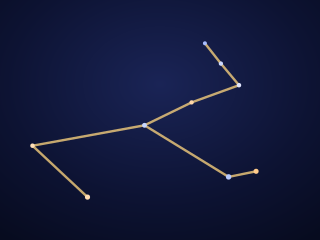 Monoceros
 Taurus