Eridanus
River Eridanus
Eridanus (River Eridanus), a river. A constellation of the southern sky; in the evening it is at its best in December. Its brightest star is Achernar.
Working out its position…
1How to find it
Eridanus is a long river of stars, the sixth largest constellation. It rises near Rigel, at Orion’s foot, with the star Cursa, then winds west and south in wide loops down to Achernar, its bright mouth, far into the southern sky. From mid-northern latitudes you can see its northern half on December and January evenings; Achernar only rises south of about latitude 33° N.
2The main stars
| Star | Name | Magnitude | Distance | Type |
|---|---|---|---|---|
| α Eridani | Achernar | 0.45 | 139 ly | B3V · blue-white, main sequence |
| β Eridani | Cursa | 2.78 | 89 ly | A3III · white giant |
| θ¹ Eridani | Acamar | 2.88 | 161 ly | A4III · white giant |
| γ Eridani | Zaurak | 2.97 | 203 ly | M1III · red supergiant |
| δ Eridani | Rana | 3.52 | 30 ly | K0IV · orange subgiant |
| υ⁴ Eridani | — | 3.55 | 178 ly | B9V · blue-white, main sequence |
| φ Eridani | — | 3.56 | 154 ly | B8IV · blue-white subgiant |
| χ Eridani | — | 3.69 | 58 ly | G5IV · yellow subgiant |
| τ⁴ Eridani | — | 3.70 | 304 ly | M3 · red giant |
| ε Eridani | Ran | 3.72 | 10 ly | K2V · orange, main sequence |
The smaller the magnitude, the brighter the star. Distances come from the Hipparcos satellite; beyond a few hundred light-years they are approximate.
3Myth and origin of the name
The river Eridanus is linked to the story of Phaethon, son of Helios, god of the Sun. To prove he really was his son, Phaethon was allowed to drive the chariot of the Sun for one day. But he could not control the fiery horses: the chariot swooped too close to the Earth, scorching the plains, then soared away, freezing the mountains. To stop the disaster Zeus struck him with a thunderbolt, and Phaethon fell into the river Eridanus.
His sisters, the Heliades, wept for him so long on the bank that they were turned into poplars, and their tears into drops of amber. The ancients identified the Eridanus with the Po in Italy, or sometimes with the Nile.
4History
It is one of the 48 constellations described by Claudius Ptolemy around AD 150 in the Almagest, the great treatise of Greek astronomy that remained the reference for more than a thousand years.
For Ptolemy the river ended at the star Acamar, whose Arabic name means “the end of the river”: Achernar, further south, could not be seen from Alexandria. The river was later extended down to it, and Achernar inherited a name with the same meaning. The star Epsilon Eridani, 10.5 light-years away, is a young nearby star surrounded by a disc of dust and at least one planet.
Its present boundaries were drawn by the Belgian astronomer Eugène Delporte and adopted by the International Astronomical Union in 1930, like those of the other 87 constellations.
5Notable objects
6When to observe it
It is fully visible from every latitude south of 32° N. From mid-northern latitudes such as France (46° N), only its northern part rises above the southern horizon; to see all of it you need to be south of latitude 32° N. In the evening around 10 pm, it is highest in the sky in December (seen from mid-northern latitudes).
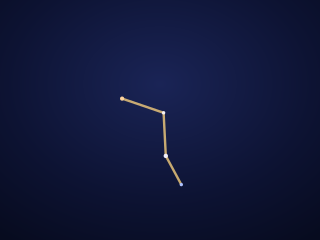 Caelum
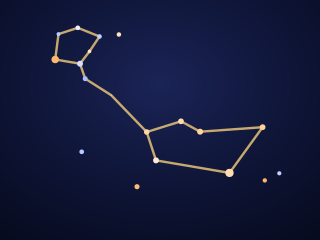 Cetus
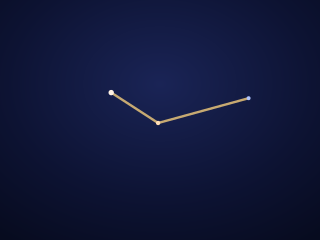 Fornax
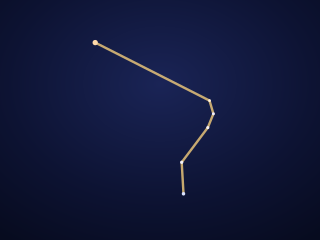 Horologium
 Hydrus
 Lepus
 Orion
 Phoenix
 Taurus