Cetus
Whale
Cetus (Whale), a sea monster. A constellation near the celestial equator, visible from both hemispheres; in the evening it is at its best in November. Its brightest star is Diphda.
Working out its position…
1How to find it
Cetus is the fourth largest constellation, but its stars are modest. It stretches below Pisces and Aries, south of the Great Square of Pegasus, on autumn evenings. Its head is a pentagon of stars south-west of Aries, marked by Menkar; its tail ends with Diphda, the brightest star, alone low in the south. Between the two lies Mira, a star that comes and goes over the months.
2The main stars
| Star | Name | Magnitude | Distance | Type |
|---|---|---|---|---|
| β Ceti | Diphda | 2.04 | 96 ly | K0III · orange giant |
| α Ceti | Menkar | 2.54 | 249 ly | M2III · red giant |
| η Ceti | — | 3.46 | 124 ly | K2III · orange giant |
| γ Ceti | Kaffaljidhma | 3.47 | 80 ly | A3V · white, main sequence |
| τ Ceti | — | 3.49 | 12 ly | G8V · yellow, main sequence |
| ι Ceti | — | 3.56 | 274 ly | K2III · orange giant |
| θ Ceti | — | 3.60 | 114 ly | K0III · orange giant |
| ζ Ceti | Baten Kaitos | 3.74 | 235 ly | K2III · orange giant |
| υ Ceti | — | 3.99 | 293 ly | K5 · orange giant |
| δ Ceti | — | 4.08 | 650 ly | B2IV · blue-white subgiant |
The smaller the magnitude, the brighter the star. Distances come from the Hipparcos satellite; beyond a few hundred light-years they are approximate.
3Myth and origin of the name
Despite its English nickname, “the Whale”, Cetus is not really a whale: it is the Greek ketos, a sea monster sent by Poseidon to ravage Cepheus’s kingdom and devour Princess Andromeda. It is shown with the head of a dog or a dragon, front legs and a long fish tail.
Perseus fought it on his way back from the Gorgons. In some versions he showed it Medusa’s head, which turned anyone who looked at it to stone. The monster remains in the sky, at the edge of the celestial waters, not far from its opponents.
4History
It is one of the 48 constellations described by Claudius Ptolemy around AD 150 in the Almagest, the great treatise of Greek astronomy that remained the reference for more than a thousand years.
In 1596 the Frisian pastor David Fabricius saw a star in Cetus fade and vanish; it later reappeared. In 1638 the Dutchman Johannes Holwarda showed that it varies with a period of about 11 months: it was named Mira, “the wonderful”. It was the first periodic variable star known. Tau Ceti, a nearby star (12 light-years) rather like the Sun, was in 1960 one of the two targets of Project Ozma, the first radio search for extraterrestrial signals.
Its present boundaries were drawn by the Belgian astronomer Eugène Delporte and adopted by the International Astronomical Union in 1930, like those of the other 87 constellations.
5Notable objects
6When to observe it
It is fully visible between latitudes 65° N and 79° S. In the evening around 10 pm, it is highest in the sky in November (seen from mid-northern latitudes).
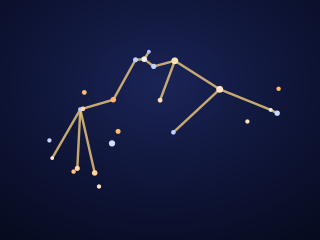 Aquarius
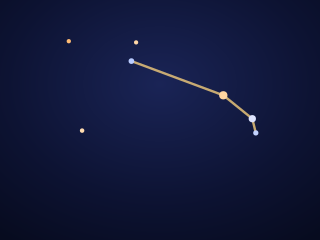 Aries
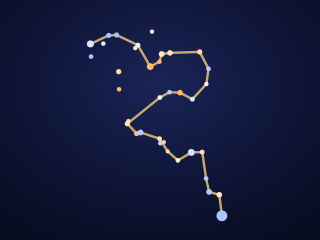 Eridanus
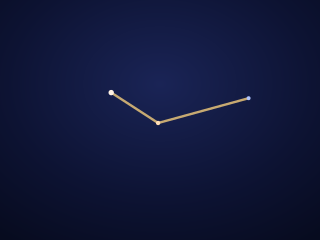 Fornax
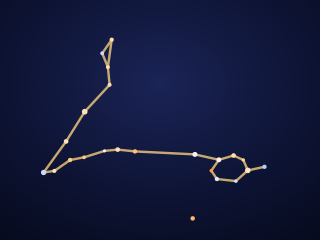 Pisces
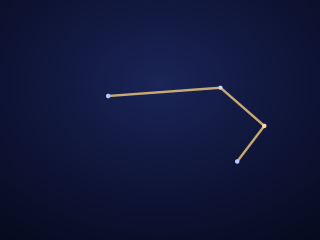 Sculptor
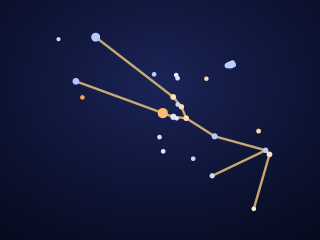 Taurus