Pisces
Fishes
Pisces (Fishes), two fish. A constellation near the celestial equator, visible from both hemispheres; in the evening it is at its best in November. Its brightest star is Alpherg.
Working out its position…
1How to find it
Pisces forms a large sideways V around the Great Square of Pegasus, along its southern and eastern sides. Its stars are faint (the brightest is magnitude 3.6), but one pattern is easy to spot under a dark sky: the “Circlet”, a small ring of seven stars just south of the Square, which is the western fish. From there a line of stars runs east to the knot, Alrescha, then climbs towards Andromeda to the northern fish. They are seen on autumn evenings.
2The main stars
| Star | Name | Magnitude | Distance | Type |
|---|---|---|---|---|
| η Piscium | Alpherg | 3.62 | 350 ly | G8III · yellow giant |
| γ Piscium | — | 3.70 | 138 ly | G7III · yellow giant |
| α Piscium | Alrescha | 3.82 | 151 ly | A2 · white |
| ω Piscium | — | 4.03 | 104 ly | F4IV · yellow-white subgiant |
| ι Piscium | — | 4.13 | 45 ly | F7V · yellow-white, main sequence |
| ο Piscium | Torcular | 4.26 | 280 ly | K0III · orange giant |
| ε Piscium | — | 4.27 | 182 ly | K0III · orange giant |
| θ Piscium | — | 4.27 | 148 ly | K1III · orange giant |
| 30 Piscium | — | 4.37 | 432 ly | M3III · red giant |
| δ Piscium | — | 4.44 | 311 ly | K5III · orange giant |
The smaller the magnitude, the brighter the star. Distances come from the Hipparcos satellite; beyond a few hundred light-years they are approximate.
3Myth and origin of the name
The two fish are tied together by their tails with a long cord. According to Greek legend, the goddess Aphrodite and her son Eros were fleeing the monster Typhon, who had come to attack the gods. They jumped into the Euphrates and turned into fish, or were carried by two fish, tying themselves together so as not to be lost in the current.
The image of a pair of tied fish is very old: it is already found in the Babylonian sky, where this region evoked rivers and irrigation canals.
4History
It is one of the 48 constellations described by Claudius Ptolemy around AD 150 in the Almagest, the great treatise of Greek astronomy that remained the reference for more than a thousand years.
The vernal point, where the Sun crosses the celestial equator in March, now lies in Pisces. It slowly drifts westwards because of precession and will enter Aquarius around the year 2600. Pisces contains van Maanen’s Star, a lone white dwarf 14 light-years away, and the beautiful spiral galaxy M74.
Its present boundaries were drawn by the Belgian astronomer Eugène Delporte and adopted by the International Astronomical Union in 1930, like those of the other 87 constellations.
5Notable objects
6When to observe it
It is fully visible between latitudes 84° N and 56° S. In the evening around 10 pm, it is highest in the sky in November (seen from mid-northern latitudes).
 Andromeda
 Aquarius
 Aries
 Cetus
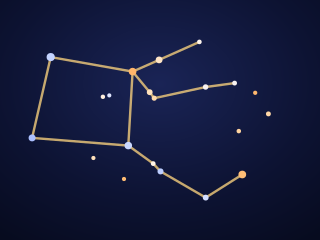 Pegasus
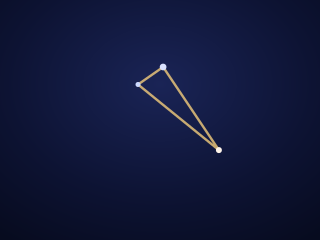 Triangulum