Aquarius
Water Bearer
Aquarius (Water Bearer), a water carrier. A constellation near the celestial equator, visible from both hemispheres; in the evening it is at its best in September. Its brightest star is Sadalsuud.
Working out its position…
1How to find it
Aquarius is large but faint, filling the autumn sky south of the Great Square of Pegasus. Its clearest landmark is the “Water Jar”, a small Y of four stars (Gamma, Zeta, Eta and Pi) just east of Sadalmelik. From there, streams of faint stars flow south-east down to Fomalhaut, the bright star of Piscis Austrinus, the fish that drinks the water poured by the jar bearer.
2The main stars
| Star | Name | Magnitude | Distance | Type |
|---|---|---|---|---|
| β Aquarii | Sadalsuud | 2.90 | 537 ly | G0Ib · yellow supergiant |
| α Aquarii | Sadalmelik | 2.95 | 524 ly | G2Ib · yellow supergiant |
| δ Aquarii | Skat | 3.27 | 161 ly | A3V · white, main sequence |
| ζ¹ Aquarii | — | 3.65 | 92 ly | F3III · yellow-white giant |
| 88 Aquarii | — | 3.68 | 271 ly | K1III · orange giant |
| λ Aquarii | — | 3.73 | 385 ly | M2III · red giant |
| ε Aquarii | Albali | 3.78 | 208 ly | A1V · white, main sequence |
| γ Aquarii | Sadachbia | 3.86 | 164 ly | A0V · white, main sequence |
| 98 Aquarii | — | 3.96 | 163 ly | K0III · orange giant |
| η Aquarii | — | 4.04 | 168 ly | B9IV · blue-white subgiant |
The smaller the magnitude, the brighter the star. Distances come from the Hipparcos satellite; beyond a few hundred light-years they are approximate.
3Myth and origin of the name
Long before the Greeks, the Babylonians saw here a divine figure tipping a vase from which two streams gush. This part of the sky was linked to the rainy season and to the realm of water: Capricornus, Pisces, Piscis Austrinus, Cetus and Eridanus surround it, so that it was sometimes nicknamed “the Sea”.
The Greeks recognised Ganymede, the young Trojan prince carried off by Zeus’s eagle to pour nectar for the gods of Olympus. Others saw Deucalion, the survivor of the great flood sent by Zeus, a story found among many peoples.
4History
It is one of the 48 constellations described by Claudius Ptolemy around AD 150 in the Almagest, the great treatise of Greek astronomy that remained the reference for more than a thousand years.
It is one of the twelve constellations of the zodiac: the Sun crosses it from mid-February to mid-March. Every year in early May, the Eta Aquariid meteor shower, made of dust left by Halley’s Comet, seems to burst out of the Water Jar.
Its present boundaries were drawn by the Belgian astronomer Eugène Delporte and adopted by the International Astronomical Union in 1930, like those of the other 87 constellations.
5Notable objects
6When to observe it
It is fully visible between latitudes 65° N and 87° S. In the evening around 10 pm, it is highest in the sky in September (seen from mid-northern latitudes).
 Aquila
 Capricornus
 Cetus
 Delphinus
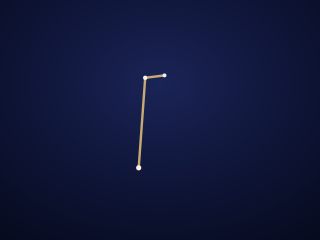 Equuleus
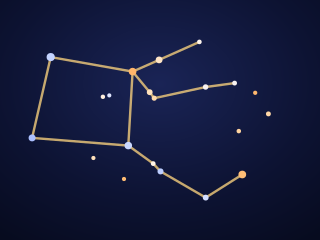 Pegasus
 Piscis Austrinus
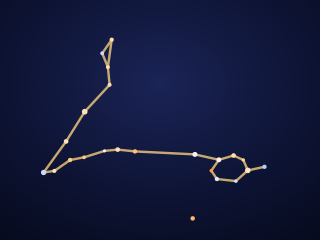 Pisces
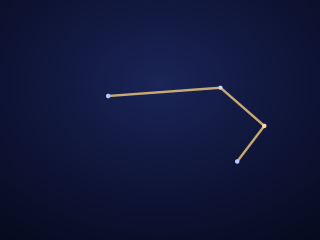 Sculptor