Equuleus
Little Horse
Equuleus (Little Horse), a foal’s head. A constellation near the celestial equator, visible from both hemispheres; in the evening it is at its best in September. Its brightest star is Kitalpha.
Working out its position…
1How to find it
Equuleus is the second smallest constellation, after Crux. It is tucked between Delphinus and Enif, the nose of Pegasus, on autumn evenings. Its four main stars, of magnitude 4 to 5, form a small trapezium; you need a dark sky to see it. First find Delphinus, which is very recognisable, then move about ten degrees to the south-east.
2The main stars
| Star | Name | Magnitude | Distance | Type |
|---|---|---|---|---|
| α Equulei | Kitalpha | 3.92 | 190 ly | G0III · yellow giant |
| δ Equulei | — | 4.47 | 60 ly | F5V · yellow-white, main sequence |
| γ Equulei | — | 4.70 | 118 ly | F0 · yellow-white |
| β Equulei | — | 5.16 | 331 ly | A3V · white, main sequence |
| HIP 103571 | — | 5.24 | 184 ly | G0V · yellow, main sequence |
| ε Equulei | — | 5.30 | 176 ly | F5III · yellow-white giant |
| HIP 0 | — | 5.40 | 60 ly | F7V · yellow-white, main sequence |
| 3 Equulei | — | 5.63 | 769 ly | K5III · orange giant |
| 9 Equulei | — | 5.81 | 655 ly | M2III · red giant |
| 4 Equulei | — | 5.94 | 160 ly | F8V · yellow-white, main sequence |
The smaller the magnitude, the brighter the star. Distances come from the Hipparcos satellite; beyond a few hundred light-years they are approximate.
3Myth and origin of the name
No reliable Greek legend is known for this little horse, shown only by its head, as if it were poking its nose ahead of Pegasus. Later writers saw it as Celeris, brother of Pegasus, said to have been given by the god Hermes to Castor, one of the Twins and a famous tamer of horses.
Its origin remains a mystery. It already appears in Ptolemy’s Almagest, but it is missing from earlier descriptions of the Greek sky, which suggests it may have been added by Hipparchus in the 2nd century BC.
4History
It is one of the 48 constellations described by Claudius Ptolemy around AD 150 in the Almagest, the great treatise of Greek astronomy that remained the reference for more than a thousand years.
Its brightest star, Kitalpha, only reaches magnitude 3.9. Its name comes from Arabic and means “the piece of the horse”.
Its present boundaries were drawn by the Belgian astronomer Eugène Delporte and adopted by the International Astronomical Union in 1930, like those of the other 87 constellations.
5Notable objects
6When to observe it
It is fully visible from every latitude north of 77° S. In the evening around 10 pm, it is highest in the sky in September (seen from mid-northern latitudes).
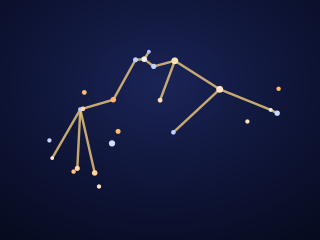 Aquarius
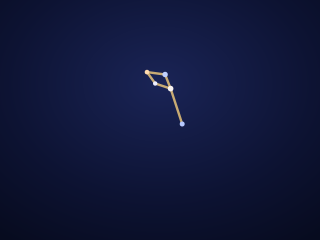 Delphinus
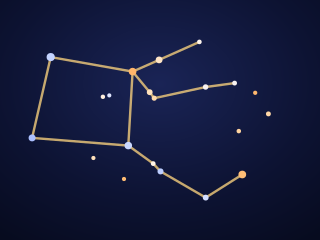 Pegasus