Draco
Dragon
Draco (Dragon), a dragon. A constellation of the northern sky; in the evening it is at its best in July. Its brightest star is Eltanin.
Working out its position…
1How to find it
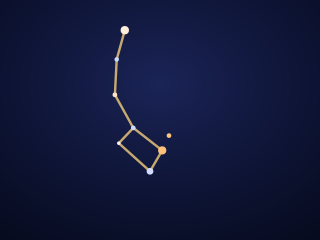
Draco winds around Ursa Minor, between the two Bears, then climbs towards Vega. Its head is the easiest landmark: a small diamond of four stars, including bright Eltanin, about fifteen degrees north-west of Vega. From the head, follow the body as it makes a wide bend around Ursa Minor, passes Thuban and ends its tail between the Big Dipper and Polaris. It is circumpolar from mid-northern latitudes.
2The main stars
| Star | Name | Magnitude | Distance | Type |
|---|---|---|---|---|
| γ Draconis | Eltanin | 2.24 | 154 ly | K5III · orange giant |
| η Draconis | Athebyne | 2.73 | 92 ly | G8III · yellow giant |
| β Draconis | Rastaban | 2.79 | 380 ly | G2II · yellow giant |
| δ Draconis | Altais | 3.07 | 97 ly | G9III · yellow giant |
| ζ Draconis | Aldhibah | 3.17 | 328 ly | B6III · blue-white giant |
| ι Draconis | Edasich | 3.29 | 101 ly | K2III · orange giant |
| χ Draconis | — | 3.55 | 26 ly | F7V · yellow-white, main sequence |
| α Draconis | Thuban | 3.67 | 303 ly | A0III · white giant |
| ξ Draconis | Grumium | 3.73 | 112 ly | K2III · orange giant |
| λ Draconis | Giausar | 3.82 | 333 ly | M0III · red giant |
The smaller the magnitude, the brighter the star. Distances come from the Hipparcos satellite; beyond a few hundred light-years they are approximate.
3Myth and origin of the name
Draco is Ladon, the hundred-headed serpent that guarded the golden apples in the garden of the Hesperides, at the edge of the world. For his eleventh labour Heracles had to bring back these fruit. Depending on the version, he killed the dragon or got the apples by a trick, with the help of the giant Atlas. Hera then placed the faithful guardian in the sky.
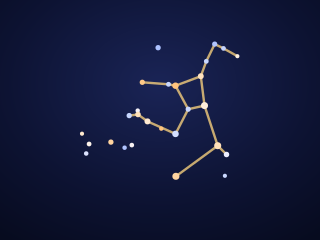
In the sky the scene is still set: Hercules, kneeling, rests one foot on Draco’s head. Another legend says that Athena, during the war against the Giants, seized a dragon and hurled it into the sky, where it stayed coiled around the pole.
4History
It is one of the 48 constellations described by Claudius Ptolemy around AD 150 in the Almagest, the great treatise of Greek astronomy that remained the reference for more than a thousand years.
About 4,700 years ago, when the great pyramids of Egypt were built, the star Thuban was the pole star: because of precession, the Earth’s axis pointed towards it. By observing Eltanin, which passed overhead in London, the Englishman James Bradley discovered the aberration of light in 1728, a proof of the Earth’s motion around the Sun. The pole of the ecliptic lies in Draco, as does the Cat’s Eye Nebula, whose spectrum William Huggins recorded in 1864, revealing that it was a glowing gas.
Its present boundaries were drawn by the Belgian astronomer Eugène Delporte and adopted by the International Astronomical Union in 1930, like those of the other 87 constellations.
5Notable objects
6When to observe it
It is fully visible from every latitude north of 4° S. From mid-northern latitudes such as France (46° N), it is circumpolar: it never sets and can be seen all year round. In the evening around 10 pm, it is highest in the sky in July (seen from mid-northern latitudes).
 Boötes
 Camelopardalis
 Cepheus
 Cygnus
 Hercules
 Lyra
 Ursa Major
 Ursa Minor