Hercules
Hercules
Hercules, a hero. A constellation of the northern sky; in the evening it is at its best in July. Its brightest star is Kornephoros.
Working out its position…
1How to find it
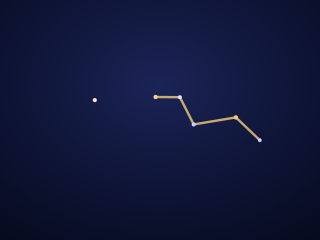
Hercules is a large summer constellation between Vega and Arcturus, above Corona Borealis. Its stars are of medium brightness, but its centre is easy to find: a quadrilateral of four stars called the “Keystone”. On the western side of this trapezium, between Eta and Zeta, you can just make out with the naked eye under a dark sky a small fuzzy star: the great cluster M13. Hercules passes overhead at mid-northern latitudes on July evenings.
2The main stars
| Star | Name | Magnitude | Distance | Type |
|---|---|---|---|---|
| β Herculis | Kornephoros | 2.78 | 139 ly | G8III · yellow giant |
| α¹ Herculis | Rasalgethi | 2.78 (variable 2.6–3.0) | 360 ly | M5II · red giant |
| ζ Herculis | — | 2.81 | 35 ly | F9IV · yellow-white subgiant |
| δ Herculis | Sarin | 3.12 | 75 ly | A3IV · white subgiant |
| π Herculis | — | 3.16 | 377 ly | K3II · orange giant |
| μ Herculis | — | 3.42 | 27 ly | G5IV · yellow subgiant |
| η Herculis | — | 3.48 | 109 ly | G8III · yellow giant |
| ξ Herculis | — | 3.70 | 137 ly | K0III · orange giant |
| γ Herculis | — | 3.74 | 193 ly | A9III · white giant |
| ι Herculis | — | 3.82 | 455 ly | B3V · blue-white, main sequence |
The smaller the magnitude, the brighter the star. Distances come from the Hipparcos satellite; beyond a few hundred light-years they are approximate.
3Myth and origin of the name
Heracles, whom the Romans called Hercules, is the most famous Greek hero, son of Zeus and a mortal woman, Alcmene. Pursued by Hera’s jealousy, he had to perform twelve labours: strangling the Nemean lion, defeating the Hydra of Lerna, fetching the golden apples of the Hesperides, capturing the hound of the underworld… When he died he was welcomed among the gods.
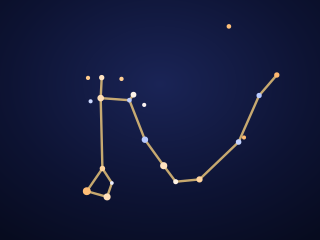
Curiously, the earliest Greeks did not know who this figure was: they simply called it “the Kneeler”. It was only identified with Heracles later. In the sky he is actually upside down, with his foot on Draco, guardian of the golden apples.
4History
It is one of the 48 constellations described by Claudius Ptolemy around AD 150 in the Almagest, the great treatise of Greek astronomy that remained the reference for more than a thousand years.
The Englishman Edmond Halley discovered the cluster M13 in 1714: it is a ball of several hundred thousand stars, about 25,000 light-years away. In 1974 the Arecibo radio telescope sent a radio message describing humanity towards it; it will take 25,000 years to arrive. William Herschel also showed in 1783 that the Sun is moving through our galaxy in the direction of Hercules.
Its present boundaries were drawn by the Belgian astronomer Eugène Delporte and adopted by the International Astronomical Union in 1930, like those of the other 87 constellations.
5Notable objects
6When to observe it
It is fully visible from every latitude north of 39° S. In the evening around 10 pm, it is highest in the sky in July (seen from mid-northern latitudes).
 Aquila
 Boötes
 Corona Borealis
 Draco
 Lyra
 Ophiuchus
 Serpens
 Sagitta
 Vulpecula