Sagitta
Arrow
Sagitta (Arrow), an arrow. A constellation of the northern sky; in the evening it is at its best in August. Its brightest star is γ Sagittae.
Working out its position…
1How to find it
Sagitta is the third smallest constellation, but its shape is perfect: four stars lined up like an arrow with its feathers. It flies between Albireo (the head of Cygnus) and Altair, inside the Summer Triangle, right in the Milky Way. It is easy to see on summer and early autumn evenings at mid-northern latitudes.
2The main stars
| Star | Name | Magnitude | Distance | Type |
|---|---|---|---|---|
| γ Sagittae | — | 3.51 | 258 ly | K5III · orange giant |
| δ Sagittae | — | 3.68 | 594 ly | M2II · red giant |
| α Sagittae | Sham | 4.39 | 425 ly | G0II · yellow giant |
| β Sagittae | — | 4.39 | 440 ly | G8II · yellow giant |
| ζ Sagittae | — | 5.01 | 255 ly | A3V · white, main sequence |
| η Sagittae | — | 5.09 | 160 ly | K2III · orange giant |
| 13 Sagittae | — | 5.33 (variable 5.3–5.5) | 1,019 ly | M4III · red supergiant |
| 11 Sagittae | — | 5.54 | 456 ly | B9III · blue-white giant |
| 1 Sagittae | — | 5.65 | 300 ly | A4V · white, main sequence |
| ε Sagittae | — | 5.67 | 480 ly | G8III · yellow giant |
The smaller the magnitude, the brighter the star. Distances come from the Hipparcos satellite; beyond a few hundred light-years they are approximate.
3Myth and origin of the name
Several legendary arrows lay claim to this constellation. The one most often mentioned belongs to Heracles: the Titan Prometheus, who had given fire to humans, was chained on the Caucasus, and every day an eagle came to devour his liver. Heracles killed the eagle with an arrow; the bird, Aquila, actually flies right next to it.
Others saw the arrow of Apollo, with which he killed the Cyclopes, or that of Eros, which made those it struck fall in love.
4History
It is one of the 48 constellations described by Claudius Ptolemy around AD 150 in the Almagest, the great treatise of Greek astronomy that remained the reference for more than a thousand years.
Sagitta contains M71, a globular cluster so loosely packed that it was long mistaken for an open cluster. Despite its small size it was already described by Ptolemy, because its shape is so striking.
Its present boundaries were drawn by the Belgian astronomer Eugène Delporte and adopted by the International Astronomical Union in 1930, like those of the other 87 constellations.
5Notable objects
6When to observe it
It is fully visible from every latitude north of 68° S. In the evening around 10 pm, it is highest in the sky in August (seen from mid-northern latitudes).
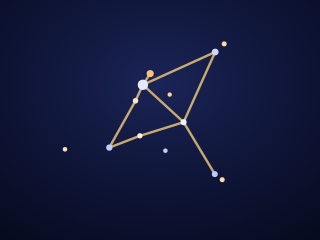 Aquila
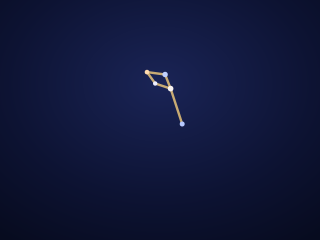 Delphinus
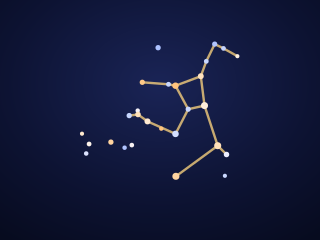 Hercules
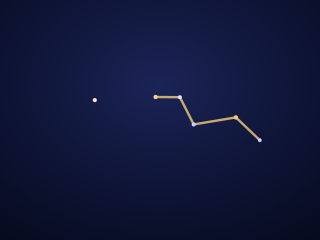 Vulpecula