Vulpecula
Little Fox
Vulpecula (Little Fox), a little fox. A constellation of the northern sky; in the evening it is at its best in August. Its brightest star is Anser.
Working out its position…
1How to find it
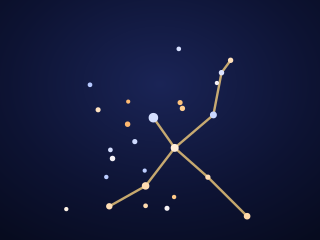
Vulpecula is a faint constellation in the middle of the Summer Triangle, between the head of Cygnus (Albireo) and Sagitta. It has no bright stars, but it contains two easy objects: the “Coathanger”, a group of ten stars shaped like a clothes hanger, visible in binoculars, and the Dumbbell Nebula (M27), within reach of a small telescope.
2The main stars
| Star | Name | Magnitude | Distance | Type |
|---|---|---|---|---|
| α Vulpeculae | Anser | 4.44 | 297 ly | M0 · red |
| 23 Vulpeculae | — | 4.50 | 339 ly | K3III · orange giant |
| 31 Vulpeculae | — | 4.56 | 188 ly | G8III · yellow giant |
| 13 Vulpeculae | — | 4.57 | 334 ly | B9.5III · blue-white giant |
| 15 Vulpeculae | — | 4.66 | 236 ly | A4III · white giant |
| 1 Vulpeculae | — | 4.76 | 811 ly | B4IV · blue-white subgiant |
| HR 7739 | — | 4.79 | 991 ly | B3V · blue-white, main sequence |
| 29 Vulpeculae | — | 4.81 | 233 ly | A0V · white, main sequence |
| 12 Vulpeculae | — | 4.90 | 630 ly | B2.5V · blue-white, main sequence |
| 30 Vulpeculae | — | 4.92 | 325 ly | K2III · orange giant |
The smaller the magnitude, the brighter the star. Distances come from the Hipparcos satellite; beyond a few hundred light-years they are approximate.
3Myth and origin of the name
Hevelius called it “the Little Fox with the Goose”: a fox carrying off a goose in its jaws. The goose has vanished from the constellation’s name, but it lives on in the name of the main star, Anser, which means “goose” in Latin.
Hevelius liked cunning animals, and he found it amusing to place this little thief right next to Aquila and Cygnus, two big birds of the summer sky.
4History
The Danzig astronomer Johannes Hevelius created it to fill a gap between older constellations. It appears in his atlas Firmamentum Sobiescianum, published in 1690, three years after his death.
The Dumbbell Nebula (M27), discovered by Charles Messier in 1764, was the first planetary nebula known. In 1967 the British student Jocelyn Bell Burnell detected in Vulpecula a radio signal repeating every 1.3 seconds: the first pulsar ever discovered, a rapidly spinning neutron star.
Its present boundaries were drawn by the Belgian astronomer Eugène Delporte and adopted by the International Astronomical Union in 1930, like those of the other 87 constellations.
5Notable objects
6When to observe it
It is fully visible from every latitude north of 61° S. In the evening around 10 pm, it is highest in the sky in August (seen from mid-northern latitudes).
 Cygnus
 Delphinus
 Hercules
 Lyra
 Pegasus
 Sagitta