Lyra
Lyre
Lyra (Lyre), a lyre, a musical instrument. A constellation of the northern sky; in the evening it is at its best in August. Its brightest star is Vega.
Working out its position…
1How to find it
Lyra is small but impossible to miss thanks to Vega, the fifth brightest star in the sky, a bluish white. Vega is the brightest and most north-westerly corner of the Summer Triangle. Right next to it, a small parallelogram of four fainter stars draws the body of the instrument. At mid-northern latitudes Vega passes almost overhead on summer evenings and stays visible for much of the year.
2The main stars
| Star | Name | Magnitude | Distance | Type |
|---|---|---|---|---|
| α Lyrae | Vega | 0.03 | 25 ly | A0V · white, main sequence |
| γ Lyrae | Sulafat | 3.25 | 620 ly | B9III · blue-white giant |
| β Lyrae | Sheliak | 3.52 (variable 3.3–4.3) | 962 ly | A8 · white, main sequence |
| 13 Lyrae | — | 4.08 (variable 4.0–4.3) | 298 ly | M5III · red giant |
| δ² Lyrae | — | 4.22 | 736 ly | M4II · red giant |
| κ Lyrae | — | 4.33 | 252 ly | K2III · orange giant |
| ζ¹ Lyrae | — | 4.34 | 156 ly | A · white |
| θ Lyrae | — | 4.35 | 832 ly | K0II · orange giant |
| η Lyrae | Aladfar | 4.43 | 1,388 ly | B2.5IV · blue-white subgiant |
| ε² Lyrae | — | 4.59 | 156 ly | A8V · white, main sequence |
The smaller the magnitude, the brighter the star. Distances come from the Hipparcos satellite; beyond a few hundred light-years they are approximate.
3Myth and origin of the name
Lyra is the lyre of Orpheus, the greatest musician of Greek mythology. The instrument had been made by Hermes from a tortoise shell, then given to Apollo, who passed it on to Orpheus. His music charmed animals, calmed storms and made trees and rocks move.
When his wife Eurydice died, Orpheus went down to the underworld and moved Hades with his song. The god agreed to give Eurydice back, on condition that Orpheus did not look back before reaching the daylight. At the last moment Orpheus turned round, and Eurydice vanished for ever. After the musician’s death, the Muses placed his lyre among the stars.
4History
It is one of the 48 constellations described by Claudius Ptolemy around AD 150 in the Almagest, the great treatise of Greek astronomy that remained the reference for more than a thousand years.
Vega is a pioneering star: it was the first star to be photographed, in 1850 at Harvard Observatory, then the first whose spectrum was photographed, in 1872. It long served as the reference point of the magnitude scale. In 1983 the IRAS satellite discovered a disc of dust around it, a sign of planet formation. In about 12,000 years, because of precession, it will be the pole star. Lyra also contains the Ring Nebula (M57) and the “double-double” star Epsilon.
Its present boundaries were drawn by the Belgian astronomer Eugène Delporte and adopted by the International Astronomical Union in 1930, like those of the other 87 constellations.
5Notable objects
6When to observe it
It is fully visible from every latitude north of 42° S. In the evening around 10 pm, it is highest in the sky in August (seen from mid-northern latitudes).
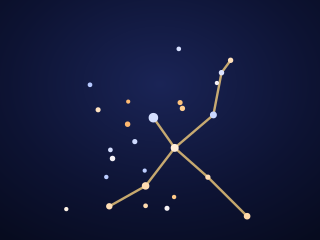 Cygnus
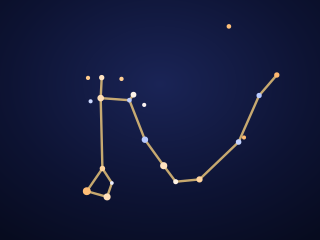 Draco
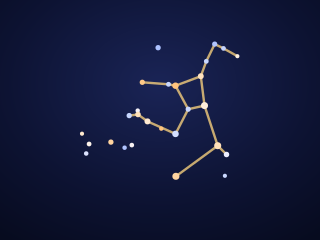 Hercules
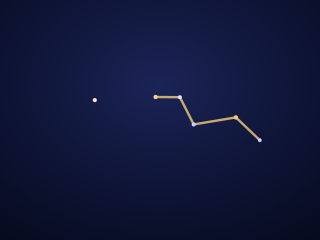 Vulpecula