Lynx
Lynx
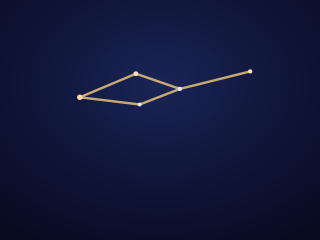
Lynx, a lynx. A constellation of the northern sky; in the evening it is at its best in February. Its brightest star is α Lyncis.
Working out its position…
1How to find it
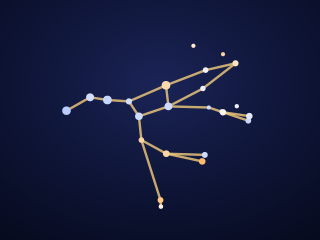
Lynx is a long chain of faint stars between Ursa Major, Auriga and Gemini. You need a very dark night to follow it. Its brightest star, Alpha, magnitude 3.1, lies at the south-eastern end, halfway between Leo’s Sickle and Castor. It is well placed on winter and spring evenings from mid-northern latitudes.
2The main stars
| Star | Name | Magnitude | Distance | Type |
|---|---|---|---|---|
| α Lyncis | — | 3.14 | 203 ly | M0III · red giant |
| 38 Lyncis | — | 3.82 | 125 ly | A1V · white, main sequence |
| HR 3579 | — | 3.96 | 52 ly | F5V · yellow-white, main sequence |
| 31 Lyncis | Alsciaukat | 4.25 | 382 ly | K5III · orange giant |
| 15 Lyncis | — | 4.35 | 178 ly | G5III · yellow giant |
| 2 Lyncis | — | 4.44 | 157 ly | A2V · white, main sequence |
| HR 3612 | — | 4.56 | 817 ly | G8Ib · yellow supergiant |
| 21 Lyncis | — | 4.61 | 274 ly | A1V · white, main sequence |
| 27 Lyncis | — | 4.78 | 250 ly | A2V · white, main sequence |
| HR 3809 | — | 4.81 | 215 ly | K0III · orange giant |
The smaller the magnitude, the brighter the star. Distances come from the Hipparcos satellite; beyond a few hundred light-years they are approximate.
3Myth and origin of the name
Hevelius created this constellation in a region of the sky with very few bright stars. He explained his choice with humour: to see it, you need the eyes of a lynx, the wild cat famous for its sharp sight.
Hevelius himself, who measured star positions without a telescope, had exceptional eyesight. Lynx is thus both a challenge to observers and a wink at his own talent.
4History
The Danzig astronomer Johannes Hevelius created it to fill a gap between older constellations. It appears in his atlas Firmamentum Sobiescianum, published in 1690, three years after his death.
Lynx contains the globular cluster NGC 2419, nicknamed the “Intergalactic Wanderer”: lying nearly 300,000 light-years away, it is so distant that it was long thought not to belong to our galaxy.
Its present boundaries were drawn by the Belgian astronomer Eugène Delporte and adopted by the International Astronomical Union in 1930, like those of the other 87 constellations.
5Notable objects
6When to observe it
It is fully visible from every latitude north of 28° S. In the evening around 10 pm, it is highest in the sky in February (seen from mid-northern latitudes).
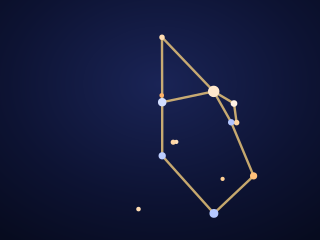 Auriga
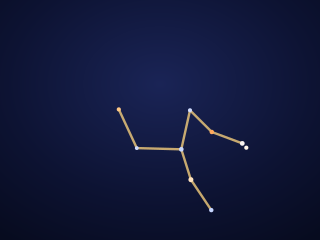 Camelopardalis
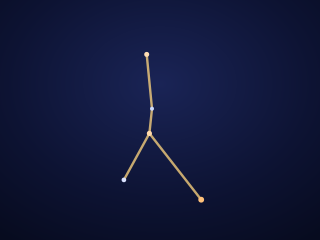 Cancer
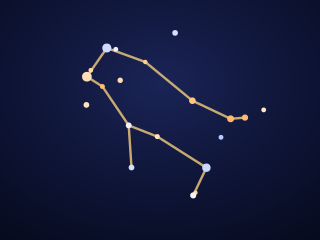 Gemini
 Leo Minor
 Ursa Major