Leo Minor
Lesser Lion
Leo Minor (Lesser Lion), a lion cub. A constellation of the northern sky; in the evening it is at its best in March. Its brightest star is Praecipua.
Working out its position…
1How to find it
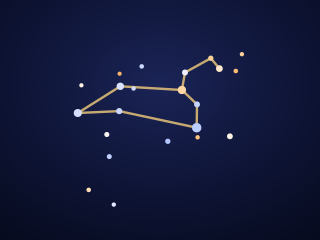
Leo Minor is a very discreet constellation slipped between the Lion’s head and the paws of the Great Bear. Its few stars of magnitude 4 to 5 form a small irregular diamond. The easiest way is to start from Leo’s Sickle and move about fifteen degrees up towards Ursa Major, on a really dark spring night.
2The main stars
| Star | Name | Magnitude | Distance | Type |
|---|---|---|---|---|
| 46 Leonis Minoris | Praecipua | 3.79 | 95 ly | K0III · orange giant |
| β Leonis Minoris | — | 4.20 | 154 ly | G8III · yellow giant |
| 21 Leonis Minoris | — | 4.49 | 92 ly | A7V · white, main sequence |
| 10 Leonis Minoris | — | 4.54 | 185 ly | G8III · yellow giant |
| 37 Leonis Minoris | — | 4.68 | 578 ly | G0II · yellow giant |
| 30 Leonis Minoris | — | 4.72 | 233 ly | F0V · yellow-white, main sequence |
| 41 Leonis Minoris | — | 5.08 | 229 ly | A3V · white, main sequence |
| 19 Leonis Minoris | — | 5.11 | 92 ly | F6V · yellow-white, main sequence |
| 42 Leonis Minoris | — | 5.36 | 382 ly | A1V · white, main sequence |
| 20 Leonis Minoris | — | 5.37 | 49 ly | G1V · yellow, main sequence |
The smaller the magnitude, the brighter the star. Distances come from the Hipparcos satellite; beyond a few hundred light-years they are approximate.
3Myth and origin of the name
Leo Minor has no legend: Hevelius drew it to fill the empty area between Leo and Ursa Major, deciding that a lion cub would keep its big neighbour good company. He also felt the animal suited stars of “the same nature” as those of Leo.
The constellation has an oddity: it has no Alpha star. In the 19th century an astronomer gave the letter Beta to one of its stars but forgot the letter Alpha; it is the star 46 that is the brightest.
4History
The Danzig astronomer Johannes Hevelius created it to fill a gap between older constellations. It appears in his atlas Firmamentum Sobiescianum, published in 1690, three years after his death.
In 2007 a Dutch schoolteacher, Hanny van Arkel, taking part in an online citizen-science project, spotted a strange green cloud near a galaxy here: “Hanny’s Voorwerp”, a cloud of gas lit up by a black hole that has since gone quiet.
Its present boundaries were drawn by the Belgian astronomer Eugène Delporte and adopted by the International Astronomical Union in 1930, like those of the other 87 constellations.
5Notable objects
6When to observe it
It is fully visible from every latitude north of 49° S. In the evening around 10 pm, it is highest in the sky in March (seen from mid-northern latitudes).
 Leo
 Lynx
 Ursa Major