Leo
Lion
Leo (Lion), a lion. A constellation of the northern sky; in the evening it is at its best in March. Its brightest star is Regulus.
Working out its position…
1How to find it
Leo is one of the few constellations that really looks like its name. Its head and mane form a large backwards question mark, “the Sickle”, ending at the bottom with Regulus, the bright star of the heart. The body continues eastwards as a triangle of stars to Denebola, the tail. To find it in spring, extend southwards the line of the two stars at the back of the Big Dipper’s bowl (the ones that point to Polaris), in the opposite direction.
2The main stars
| Star | Name | Magnitude | Distance | Type |
|---|---|---|---|---|
| α Leonis | Regulus | 1.36 | 79 ly | B7V · blue-white, main sequence |
| γ¹ Leonis | Algieba | 2.01 | 130 ly | K0III · orange giant |
| β Leonis | Denebola | 2.14 | 36 ly | A3V · white, main sequence |
| δ Leonis | Zosma | 2.56 | 58 ly | A4V · white, main sequence |
| ε Leonis | Ras Elased Australis | 2.97 | 247 ly | G0II · yellow giant |
| θ Leonis | Chertan | 3.33 | 165 ly | A2V · white, main sequence |
| ζ Leonis | Adhafera | 3.43 | 274 ly | F0III · yellow-white giant |
| η Leonis | — | 3.48 | 1,269 ly | A0Ib · white supergiant |
| ο Leonis | Subra | 3.52 | 130 ly | A5V · white, main sequence |
| ρ Leonis | — | 3.84 | — | B1Ib · blue-white supergiant |
The smaller the magnitude, the brighter the star. Distances come from the Hipparcos satellite; beyond a few hundred light-years they are approximate.
3Myth and origin of the name
It is the Nemean lion, a beast with an impenetrable hide that terrorised the region of Corinth. It was the first of Heracles’s twelve labours: his arrows bounced off the animal and his sword bent. The hero finally strangled it with his bare hands, then cut its skin with the lion’s own claws. He wore the fur ever after as armour, with the lion’s jaws as a helmet.
Long before the Greeks, the Babylonians and Egyptians already saw a lion in these stars. In their time the Sun passed through Leo in high summer, when lions left the scorching desert to drink from the flooding Nile.
4History
It is one of the 48 constellations described by Claudius Ptolemy around AD 150 in the Almagest, the great treatise of Greek astronomy that remained the reference for more than a thousand years.
Regulus, “the little king” in Latin, lies almost on the ecliptic: the Moon and planets often pass close to it, and the Moon regularly hides it. Every year around 17 November, the Leonid meteors, from comet Tempel-Tuttle, seem to burst out of the mane; in 1833 and 1966 they produced true storms of thousands of meteors an hour. Leo also contains a fine trio of galaxies, M65, M66 and NGC 3628.
Its present boundaries were drawn by the Belgian astronomer Eugène Delporte and adopted by the International Astronomical Union in 1930, like those of the other 87 constellations.
5Notable objects
6When to observe it
It is fully visible between latitudes 83° N and 57° S. In the evening around 10 pm, it is highest in the sky in March (seen from mid-northern latitudes).
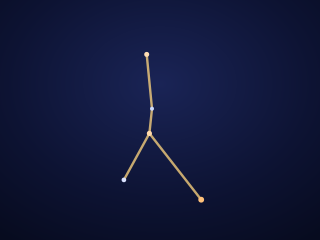 Cancer
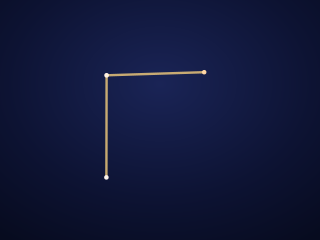 Coma Berenices
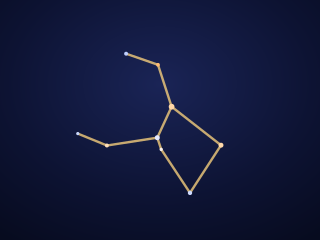 Crater
 Hydra
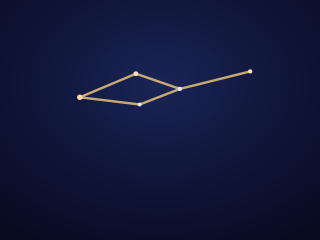 Leo Minor
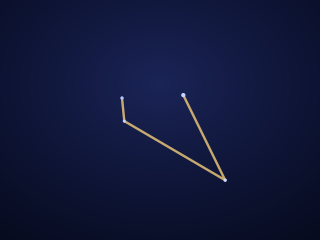 Sextans
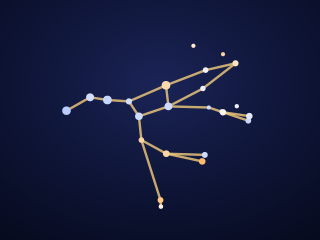 Ursa Major
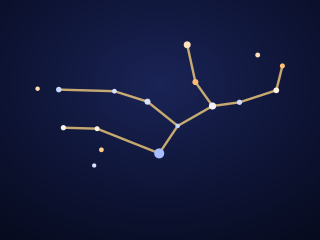 Virgo