Lacerta
Lizard
Lacerta (Lizard), a lizard. A constellation of the northern sky; in the evening it is at its best in September. Its brightest star is α Lacertae.
Working out its position…
1How to find it
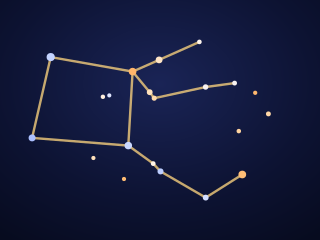
Lacerta is a small zigzag constellation squeezed between Cygnus, Cepheus, Cassiopeia and Andromeda. Its stars of magnitude 4 to 5 trace a tight little W or a broken line, like a lizard darting along. To find it, start from Deneb and head towards Cassiopeia: Lacerta lies roughly halfway, in the Milky Way. It is well placed on autumn evenings from mid-northern latitudes.
2The main stars
| Star | Name | Magnitude | Distance | Type |
|---|---|---|---|---|
| α Lacertae | — | 3.76 | 103 ly | A1V · white, main sequence |
| 1 Lacertae | — | 4.14 | 621 ly | K3III · orange giant |
| 5 Lacertae | — | 4.34 | 1,647 ly | M0II · red giant |
| β Lacertae | — | 4.42 | 170 ly | G9III · yellow giant |
| HR 8485 | — | 4.50 | 482 ly | K3III · orange giant |
| 11 Lacertae | — | 4.50 | 333 ly | K3III · orange giant |
| 6 Lacertae | — | 4.52 | 1,717 ly | B2IV · blue-white subgiant |
| 2 Lacertae | — | 4.55 | 555 ly | B6V · blue-white, main sequence |
| 4 Lacertae | — | 4.55 | 2,249 ly | B9Ia · blue-white supergiant |
| 9 Lacertae | — | 4.64 | 172 ly | A8IV · white subgiant |
The smaller the magnitude, the brighter the star. Distances come from the Hipparcos satellite; beyond a few hundred light-years they are approximate.
3Myth and origin of the name
Hevelius created Lacerta to fill an empty space between older constellations. He actually hesitated between a lizard and a newt, a small amphibian he called Stellio: on his charts the animal is a bit of both.
Other astronomers tried to give this little corner of sky another name, to honour a king or ruler of their day, but none of these proposals survived: only Hevelius’s humble lizard has remained.
4History
The Danzig astronomer Johannes Hevelius created it to fill a gap between older constellations. It appears in his atlas Firmamentum Sobiescianum, published in 1690, three years after his death.
In 1929 a “variable star” was noticed here, BL Lacertae. Decades later astronomers realised it is actually the core of a distant galaxy, where a giant black hole fires a jet of matter straight towards us. It gave its name to a whole family of objects, the “BL Lac objects”.
Its present boundaries were drawn by the Belgian astronomer Eugène Delporte and adopted by the International Astronomical Union in 1930, like those of the other 87 constellations.
5Notable objects
6When to observe it
It is fully visible from every latitude north of 33° S. In the evening around 10 pm, it is highest in the sky in September (seen from mid-northern latitudes).
 Andromeda
 Cassiopeia
 Cepheus
 Cygnus
 Pegasus