Cassiopeia
Cassiopeia
Cassiopeia, a queen on her throne. A constellation of the northern sky; in the evening it is at its best in November. Its brightest star is Cih.
Working out its position…
1How to find it
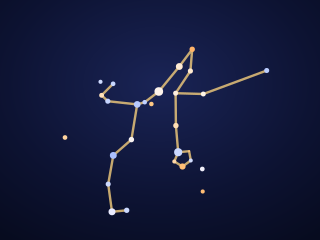
Cassiopeia draws a big W (or an M, depending on the time) of five stars of magnitude 2 to 3, impossible to miss. It lies on the opposite side of Polaris from the Big Dipper: when one is high, the other is low. From mid-northern latitudes it is circumpolar and visible all year, highest on autumn evenings. The Milky Way runs through it.
2The main stars
| Star | Name | Magnitude | Distance | Type |
|---|---|---|---|---|
| γ Cassiopeiae | Cih | 2.15 | 549 ly | B0IV · blue-white subgiant |
| α Cassiopeiae | Schedar | 2.24 | 228 ly | K0II · orange giant |
| β Cassiopeiae | Caph | 2.28 | 55 ly | F2III · yellow-white giant |
| δ Cassiopeiae | Ruchbah | 2.66 | 99 ly | A5V · white, main sequence |
| ε Cassiopeiae | Segin | 3.35 | 412 ly | B2 · blue-white |
| η Cassiopeiae | Achird | 3.46 | 19 ly | G0V · yellow, main sequence |
| ζ Cassiopeiae | Fulu | 3.69 | 593 ly | B2IV · blue-white subgiant |
| 50 Cassiopeiae | — | 3.95 | 157 ly | A2V · white, main sequence |
| κ Cassiopeiae | — | 4.17 | — | B1Ia · blue-white supergiant |
| θ Cassiopeiae | — | 4.34 | 134 ly | A7V · white, main sequence |
The smaller the magnitude, the brighter the star. Distances come from the Hipparcos satellite; beyond a few hundred light-years they are approximate.
3Myth and origin of the name
Cassiopeia is the queen of Ethiopia, wife of Cepheus and mother of Andromeda. Her vanity caused her daughter’s misfortune: she claimed to be more beautiful than the Nereids, and Poseidon sent a sea monster to ravage the kingdom.
To punish her, the gods placed her in the sky sitting on her throne, close to the pole. She circles it every night and spends part of the time upside down, an eternal humiliation for someone who wanted to be admired. Some versions add that she is tied to her chair so as not to fall.
4History
It is one of the 48 constellations described by Claudius Ptolemy around AD 150 in the Almagest, the great treatise of Greek astronomy that remained the reference for more than a thousand years.
In November 1572 a new star appeared in Cassiopeia and became brighter than Venus. The Dane Tycho Brahe measured it carefully and showed that it lay far beyond the Moon: the heavens, thought to be unchanging, could therefore change. It was a supernova. Cassiopeia also contains Cassiopeia A, the remnant of another supernova that occurred around 1680, now one of the strongest radio sources in the sky.
Its present boundaries were drawn by the Belgian astronomer Eugène Delporte and adopted by the International Astronomical Union in 1930, like those of the other 87 constellations.
5Notable objects
6When to observe it
It is fully visible from every latitude north of 12° S. From mid-northern latitudes such as France (46° N), it is circumpolar: it never sets and can be seen all year round. In the evening around 10 pm, it is highest in the sky in November (seen from mid-northern latitudes).
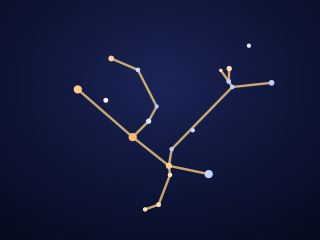 Andromeda
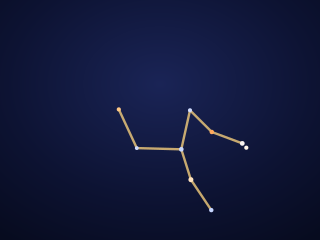 Camelopardalis
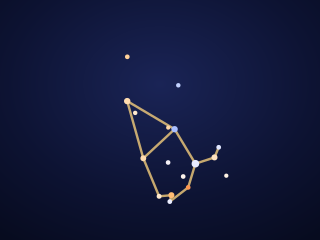 Cepheus
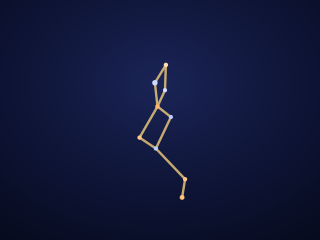 Lacerta
 Perseus