Cepheus
Cepheus
Cepheus, a king. A constellation of the northern sky; in the evening it is at its best in September. Its brightest star is Alderamin.
Working out its position…
1How to find it
Cepheus looks like a small house with a pointed roof, or a church steeple, drawn by five stars of magnitude 2 to 3.5. It lies between Cassiopeia and Polaris, with the top of the roof pointing towards Polaris. From mid-northern latitudes it is circumpolar and always visible, highest in autumn. Find Alderamin, the brightest star, at the foot of the house on the side facing Cygnus.
2The main stars
| Star | Name | Magnitude | Distance | Type |
|---|---|---|---|---|
| α Cephei | Alderamin | 2.45 | 49 ly | A7IV · white subgiant |
| γ Cephei | Errai | 3.21 | 46 ly | K1IV · orange subgiant |
| β Cephei | Alfirk | 3.23 | 685 ly | B2III · blue-white giant |
| ζ Cephei | — | 3.39 | 836 ly | K1Ib · orange supergiant |
| η Cephei | — | 3.41 | 46 ly | K0IV · orange subgiant |
| ι Cephei | — | 3.50 | 115 ly | K0III · orange giant |
| δ Cephei | — | 4.07 (variable 3.6–4.3) | 865 ly | G2Ib · yellow supergiant |
| ε Cephei | — | 4.18 | 85 ly | F0IV · yellow-white subgiant |
| θ Cephei | — | 4.21 | 136 ly | A7III · white giant |
| μ Cephei | — | 4.23 (variable 3.9–4.5) | — | M2Ia · red supergiant |
The smaller the magnitude, the brighter the star. Distances come from the Hipparcos satellite; beyond a few hundred light-years they are approximate.
3Myth and origin of the name
Cepheus is the king of Ethiopia, husband of Cassiopeia and father of Andromeda. He plays a modest role in the myth: it was he who consulted the oracle and agreed, heavy-hearted, to give up his daughter to the sea monster to save his people.
The gods placed him near the pole beside his wife, but his constellation is much fainter than the queen’s, as if the sky too had remembered which of them had the stronger personality.
4History
It is one of the 48 constellations described by Claudius Ptolemy around AD 150 in the Almagest, the great treatise of Greek astronomy that remained the reference for more than a thousand years.
In 1784 the young English astronomer John Goodricke, deaf since childhood, discovered that Delta Cephei varies in brightness every 5 days and 9 hours. These “Cepheid” stars later allowed the American Henrietta Leavitt (1912) to find a law linking their period to their luminosity: an essential tool for measuring the distances of galaxies. Cepheus also contains William Herschel’s Garnet Star (Mu Cephei), a deep red supergiant. Because of precession, Errai (Gamma) will become the pole star around the year 4000.
Its present boundaries were drawn by the Belgian astronomer Eugène Delporte and adopted by the International Astronomical Union in 1930, like those of the other 87 constellations.
5Notable objects
6When to observe it
It is fully visible from every latitude north of 1° S. From mid-northern latitudes such as France (46° N), it is circumpolar: it never sets and can be seen all year round. In the evening around 10 pm, it is highest in the sky in September (seen from mid-northern latitudes).
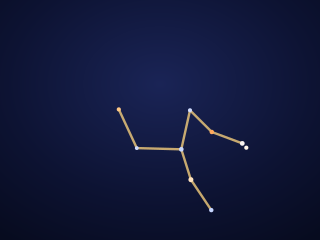 Camelopardalis
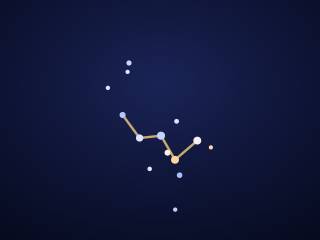 Cassiopeia
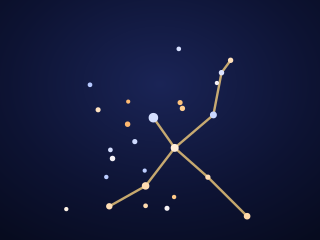 Cygnus
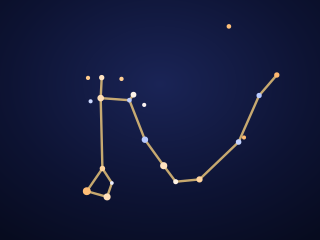 Draco
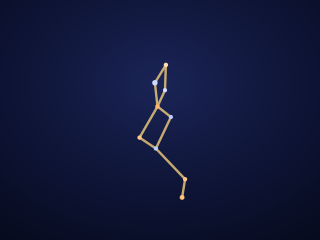 Lacerta
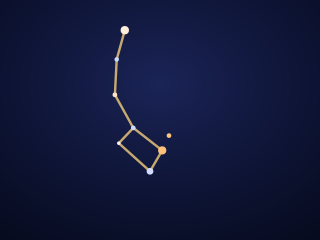 Ursa Minor