Ursa Minor
Little Bear
Ursa Minor (Little Bear), a little bear. A constellation of the northern sky; in the evening it is at its best in June. Its brightest star is Polaris.
Working out its position…
1How to find it
Ursa Minor looks like a small dipper, fainter than the big one. The end of its handle is Polaris, which stays almost still above the northern horizon while the whole sky turns. To find it, extend the distance between Merak and Dubhe, the two stars at the end of the Big Dipper’s bowl, about five times. The bowl of the Little Bear is marked by Kochab and Pherkad, the “Guardians of the Pole”. It is visible all year round from mid-northern latitudes.
2The main stars
| Star | Name | Magnitude | Distance | Type |
|---|---|---|---|---|
| α Ursae Minoris | Polaris | 1.97 | 433 ly | F7 · yellow-white supergiant |
| β Ursae Minoris | Kochab | 2.07 | 131 ly | K4III · orange giant |
| γ Ursae Minoris | Pherkad | 3.00 | 487 ly | A3II · white giant |
| ε Ursae Minoris | — | 4.21 | 304 ly | G5III · yellow giant |
| 5 Ursae Minoris | — | 4.25 | 359 ly | K4III · orange giant |
| ζ Ursae Minoris | — | 4.29 | 369 ly | A3V · white, main sequence |
| δ Ursae Minoris | Yildun | 4.35 | 172 ly | A1V · white, main sequence |
| HR 5589 | — | 4.63 (variable 4.5–4.8) | 459 ly | M5III · red giant |
| 4 Ursae Minoris | — | 4.80 | 457 ly | K3III · orange giant |
| η Ursae Minoris | — | 4.95 | 97 ly | F5V · yellow-white, main sequence |
The smaller the magnitude, the brighter the star. Distances come from the Hipparcos satellite; beyond a few hundred light-years they are approximate.
3Myth and origin of the name
For some Greeks, the Little Bear is Arcas, son of Callisto, placed near his mother. For others it is one of the two nymphs who hid and fed the infant Zeus in a cave in Crete. The Greeks also called it Kynosoura, “the dog’s tail”, a name long used for the pole star.
It is said that Phoenician sailors steered by the Little Bear, closer to the pole, while the Greeks used the Great Bear; the scholar Thales of Miletus is said to have advised Greek sailors to follow the Phoenician example.
4History
It is one of the 48 constellations described by Claudius Ptolemy around AD 150 in the Almagest, the great treatise of Greek astronomy that remained the reference for more than a thousand years.
Polaris has not always been the pole star: the Earth’s axis traces a large circle every 26,000 years. Three thousand years ago Kochab was closer to the pole than Polaris. Today Polaris is less than one degree from the pole, and it will get closer still until around 2100. It is also a Cepheid, a star that pulses slightly over four days.
Its present boundaries were drawn by the Belgian astronomer Eugène Delporte and adopted by the International Astronomical Union in 1930, like those of the other 87 constellations.
5Notable objects
6When to observe it
It is fully visible from every latitude north of 0° N. From mid-northern latitudes such as France (46° N), it is circumpolar: it never sets and can be seen all year round. In the evening around 10 pm, it is highest in the sky in June (seen from mid-northern latitudes).
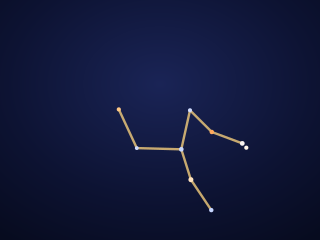 Camelopardalis
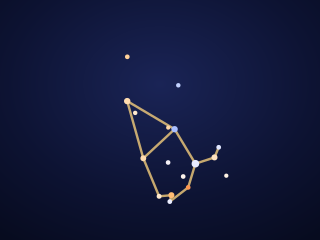 Cepheus
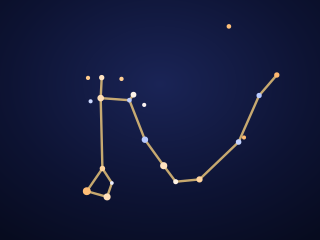 Draco