Vela
Sails
Vela (Sails), the sails of a ship. A constellation of the southern sky; in the evening it is at its best in March. Its brightest star is γ² Velorum.
Working out its position…
1How to find it
Vela forms the upper part of the ship Argo, in a very rich region of the southern Milky Way, between Puppis, Carina and Centaurus. Its bright stars outline a large polygon; two of them, Delta and Kappa, form with two stars of Carina the “False Cross”, often mistaken for the Southern Cross. From southern Europe only the northern fringe of Vela grazes the horizon in February and March.
2The main stars
| Star | Name | Magnitude | Distance | Type |
|---|---|---|---|---|
| γ² Velorum | — | 1.75 | 1,117 ly | WC8 · supergiant |
| δ Velorum | Alsephina | 1.93 | 81 ly | A1V · white, main sequence |
| λ Velorum | Suhail | 2.23 | 544 ly | K4Ib · orange supergiant |
| κ Velorum | Markeb | 2.47 | 572 ly | B2IV · blue-white subgiant |
| μ Velorum | — | 2.69 | 117 ly | G5III · yellow giant |
| HR 3803 | — | 3.16 | 239 ly | K5III · orange giant |
| φ Velorum | — | 3.52 | 1,591 ly | B5Ib · blue-white supergiant |
| ο Velorum | — | 3.60 | 493 ly | B3IV · blue-white subgiant |
| ψ Velorum | — | 3.60 | 61 ly | F2IV · yellow-white subgiant |
| HR 3614 | — | 3.75 | 300 ly | K2III · orange giant |
The smaller the magnitude, the brighter the star. Distances come from the Hipparcos satellite; beyond a few hundred light-years they are approximate.
3Myth and origin of the name
The Sails belong to the ship Argo, which carried Jason and the Argonauts to Colchis. In the tale told by Apollonius of Rhodes, the ship came through many trials, the clashing rocks, the Sirens, storms, before bringing back the golden fleece.
Like Puppis, Vela has neither an Alpha nor a Beta star: when Argo was split up, Lacaille kept a single series of Greek letters for the whole ship, and the first letters went to Carina.
4History
It was once part of Argo, the enormous ship described by Ptolemy. Too large to be practical, Argo was divided by Nicolas-Louis de Lacaille into three constellations, Carina, Puppis and Vela, in his catalogue of southern stars published in 1763.
About 11,000 years ago a star exploded in Vela; it left a huge filamentary cloud and a neutron star, the Vela Pulsar, which spins 11 times a second. Gamma Velorum is the brightest Wolf-Rayet star in the sky, a very hot star losing matter at great speed. Vela also contains the planetary nebula NGC 3132, one of the first targets photographed by the James Webb Space Telescope in 2022.
Its present boundaries were drawn by the Belgian astronomer Eugène Delporte and adopted by the International Astronomical Union in 1930, like those of the other 87 constellations.
5Notable objects
6When to observe it
It is fully visible from every latitude south of 33° N. From mid-northern latitudes such as France (46° N), only its northern part rises above the southern horizon; to see all of it you need to be south of latitude 33° N. In the evening around 10 pm, it is highest in the sky in March (seen from mid-northern latitudes).
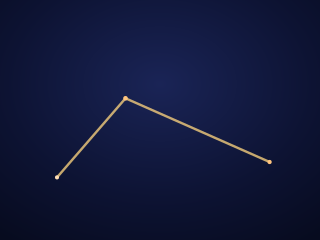 Antlia
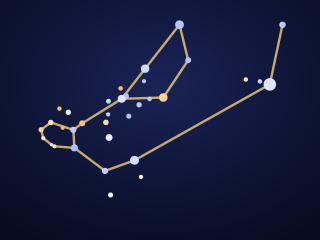 Carina
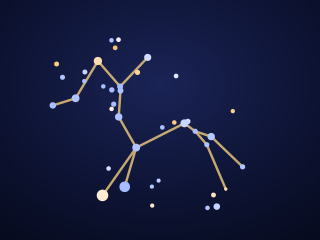 Centaurus
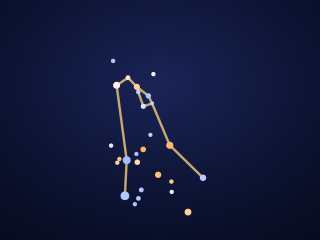 Puppis
 Pyxis