Virgo
Maiden
Virgo (Maiden), a young woman holding an ear of wheat. A constellation near the celestial equator, visible from both hemispheres; in the evening it is at its best in May. Its brightest star is Spica.
Working out its position…
1How to find it
Virgo is the second largest constellation in the sky. Its main star, blue-white Spica (magnitude 1), is easy to find in spring: follow the curve of the Big Dipper’s handle to Arcturus, then carry on along the same curve southwards to Spica. The rest of Virgo spreads out as a sideways Y north-west of Spica, towards the Lion’s tail.
2The main stars
| Star | Name | Magnitude | Distance | Type |
|---|---|---|---|---|
| α Virginis | Spica | 0.98 | 250 ly | B1V · blue-white, main sequence |
| γ Virginis | Porrima | 2.74 | 38 ly | F0V · yellow-white, main sequence |
| ε Virginis | Vindemiatrix | 2.85 | 110 ly | G8III · yellow giant |
| ζ Virginis | Heze | 3.38 | 74 ly | A3V · white, main sequence |
| δ Virginis | Minelauva | 3.39 | 198 ly | M3III · red giant |
| γ Virginis | — | 3.52 | 39 ly | F0V · yellow-white, main sequence |
| β Virginis | Zavijava | 3.59 | 36 ly | F8V · yellow-white, main sequence |
| 109 Virginis | — | 3.73 | 134 ly | A0V · white, main sequence |
| μ Virginis | — | 3.87 | 60 ly | F2III · yellow-white giant |
| η Virginis | Zaniah | 3.89 | 265 ly | A2IV · white subgiant |
The smaller the magnitude, the brighter the star. Distances come from the Hipparcos satellite; beyond a few hundred light-years they are approximate.
3Myth and origin of the name
Virgo holds an ear of wheat in her hand: that is the meaning of the Latin name Spica. She was linked to the goddesses of the harvest, Demeter or her daughter Persephone, whose stay in the underworld each winter explained the turning of the seasons.
Another tradition sees Astraea, goddess of justice. In the golden age the gods lived among humans. When people became greedy and violent, the immortals left one by one; Astraea was the last to leave the Earth and rose into the sky, where she keeps the Scales of justice close by.
4History
It is one of the 48 constellations described by Claudius Ptolemy around AD 150 in the Almagest, the great treatise of Greek astronomy that remained the reference for more than a thousand years.
Around 130 BC the Greek astronomer Hipparchus, comparing his measurements of Spica with those made a century and a half earlier, discovered the precession of the equinoxes. Virgo contains the great Virgo galaxy cluster, with more than a thousand members, and the giant galaxy M87, whose central black hole was the subject of the very first image of a black hole, published in 2019. The first quasar identified, 3C 273, is also here (1963).
Its present boundaries were drawn by the Belgian astronomer Eugène Delporte and adopted by the International Astronomical Union in 1930, like those of the other 87 constellations.
5Notable objects
6When to observe it
It is fully visible between latitudes 67° N and 76° S. In the evening around 10 pm, it is highest in the sky in May (seen from mid-northern latitudes).
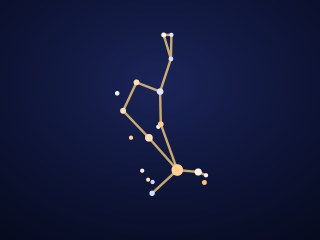 Boötes
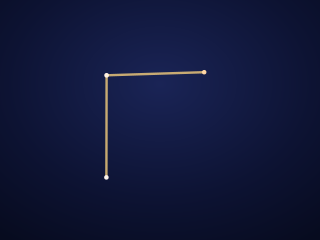 Coma Berenices
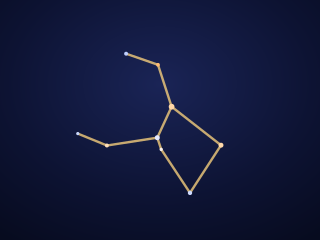 Crater
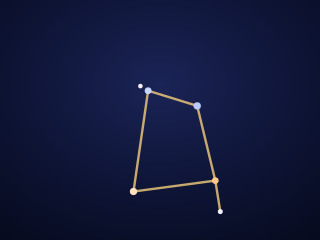 Corvus
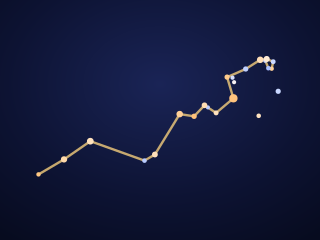 Hydra
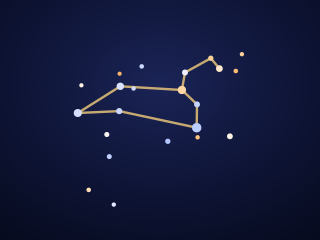 Leo
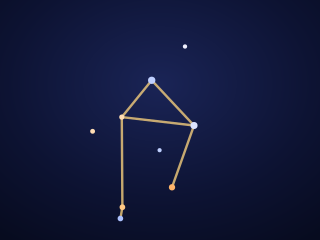 Libra
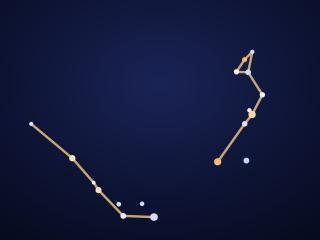 Serpens