Corvus
Crow
Corvus (Crow), a crow. A constellation of the southern sky; in the evening it is at its best in April. Its brightest star is Gienah.
Working out its position…
1How to find it
Corvus is a small quadrilateral of four stars of magnitude 2.5 to 3, easy to see low in the south in spring. To find it, follow the arc of the Big Dipper’s handle to Arcturus, then carry on along the curve to Spica (in Virgo). Corvus lies just south-west of Spica: its four stars form a small, tilted sail.
2The main stars
| Star | Name | Magnitude | Distance | Type |
|---|---|---|---|---|
| γ Corvi | Gienah | 2.58 | 154 ly | B8III · blue-white giant |
| β Corvi | Kraz | 2.65 | 146 ly | G5II · yellow giant |
| δ Corvi | Algorab | 2.94 | 87 ly | B9.5V · blue-white, main sequence |
| ε Corvi | — | 3.02 | 318 ly | K2III · orange giant |
| α Corvi | Alchiba | 4.02 | 49 ly | F0IV · yellow-white subgiant |
| η Corvi | — | 4.30 | 60 ly | F2V · yellow-white, main sequence |
| HR 4699 | — | 5.14 | 201 ly | K0III · orange giant |
| HR 4821 | — | 5.17 | 257 ly | F3IV · yellow-white subgiant |
| ζ Corvi | — | 5.20 | 416 ly | B8V · blue-white, main sequence |
| HR 4590 | — | 5.28 | 3,167 ly | B2IV · blue-white subgiant |
The smaller the magnitude, the brighter the star. Distances come from the Hipparcos satellite; beyond a few hundred light-years they are approximate.
3Myth and origin of the name
One day the god Apollo sent his crow to fetch fresh water in a cup for a sacrifice. On the way the bird stopped at a fig tree whose fruit was still green and waited for it to ripen so it could have a feast. Arriving back very late, it brought a water snake in its claws and blamed the creature for the delay.
Apollo was not fooled. He put the crow, the cup and the snake in the sky: Corvus, Crater and Hydra. The snake guards the cup, and the crow, thirsty for ever, can never drink from it.
4History
It is one of the 48 constellations described by Claudius Ptolemy around AD 150 in the Almagest, the great treatise of Greek astronomy that remained the reference for more than a thousand years.
Corvus contains the “Antennae”, two galaxies in the middle of a collision (NGC 4038 and 4039) whose torn-out tails of stars look like an insect’s antennae. They show what may one day happen to our galaxy and the Andromeda Galaxy.
Its present boundaries were drawn by the Belgian astronomer Eugène Delporte and adopted by the International Astronomical Union in 1930, like those of the other 87 constellations.
5Notable objects
6When to observe it
It is fully visible from every latitude south of 65° N. In the evening around 10 pm, it is highest in the sky in April (seen from mid-northern latitudes).
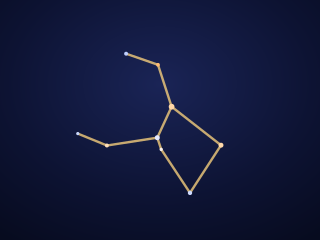 Crater
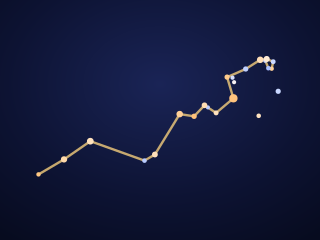 Hydra
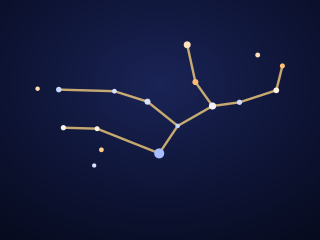 Virgo