Hydra
Water Snake
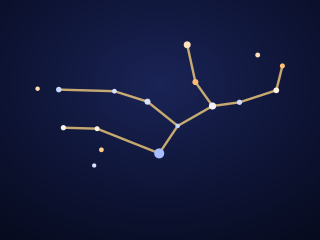
Hydra (Water Snake), a water snake. A constellation of the southern sky; in the evening it is at its best in March. Its brightest star is Alphard.
Working out its position…
1How to find it
Hydra is the largest of the 88 constellations: it stretches across more than 100° of sky, over a quarter of the way around the horizon. Its head is a small ring of six stars below Cancer and east of Procyon. From there its long body runs down to Alphard, its brightest star, orange and solitary, then winds below Leo, Crater and Corvus as far as the edge of Libra. It takes several hours to rise completely; it is best seen in spring.
2The main stars
| Star | Name | Magnitude | Distance | Type |
|---|---|---|---|---|
| α Hydrae | Alphard | 1.99 | 180 ly | K3III · orange giant |
| γ Hydrae | — | 2.99 | 134 ly | G8III · yellow giant |
| ζ Hydrae | — | 3.11 | 167 ly | G8III · yellow giant |
| ν Hydrae | — | 3.11 | 144 ly | K0 · orange giant |
| π Hydrae | — | 3.25 | 101 ly | K2III · orange giant |
| ε Hydrae | Ashlesha | 3.38 | 129 ly | G0III · yellow giant |
| ξ Hydrae | — | 3.54 | 130 ly | G8III · yellow giant |
| λ Hydrae | — | 3.61 | 112 ly | K0III · orange giant |
| μ Hydrae | — | 3.83 | 234 ly | K4III · orange giant |
| θ Hydrae | — | 3.89 | 114 ly | B9.5V · blue-white, main sequence |
The smaller the magnitude, the brighter the star. Distances come from the Hipparcos satellite; beyond a few hundred light-years they are approximate.
3Myth and origin of the name
The Hydra of Lerna was a monstrous many-headed water snake that lived in the marshes near Argos. Each time Heracles cut off a head, two more grew back. To finish it off, his nephew Iolaus burnt each severed neck with a torch; as for the immortal head, Heracles buried it under a huge rock. He then dipped his arrows in the monster’s venom.
Hydra is also the water snake in the story of Apollo’s crow: placed in the sky below Crater and Corvus, it stops the lying bird from drinking.
4History
It is one of the 48 constellations described by Claudius Ptolemy around AD 150 in the Almagest, the great treatise of Greek astronomy that remained the reference for more than a thousand years.
Its main star, Alphard, has an Arabic name meaning “the solitary one”: no bright star surrounds it. Hydra contains the beautiful spiral galaxy M83, the “Southern Pinwheel”, and the planetary nebula NGC 3242, nicknamed the “Ghost of Jupiter” because in a telescope its size and colour resemble the planet’s.
Its present boundaries were drawn by the Belgian astronomer Eugène Delporte and adopted by the International Astronomical Union in 1930, like those of the other 87 constellations.
5Notable objects
6When to observe it
It is fully visible between latitudes 54° N and 83° S. In the evening around 10 pm, it is highest in the sky in March (seen from mid-northern latitudes).
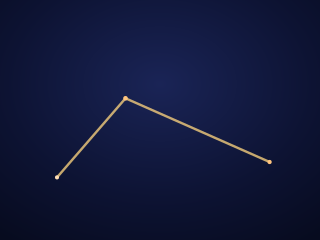 Antlia
 Canis Minor
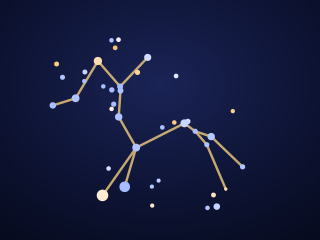 Centaurus
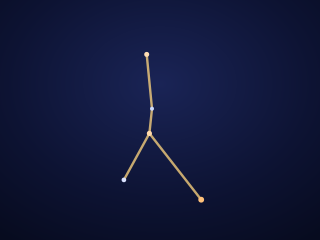 Cancer
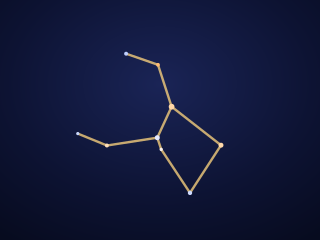 Crater
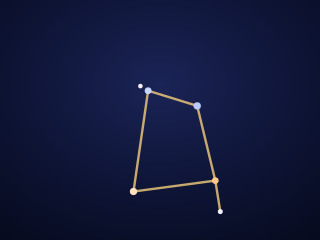 Corvus
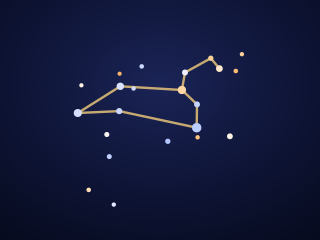 Leo
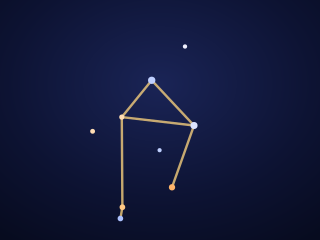 Libra
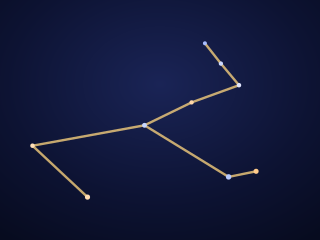 Monoceros
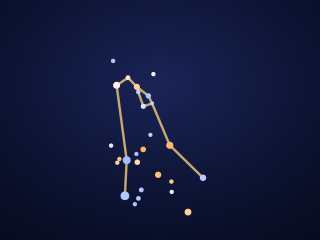 Puppis
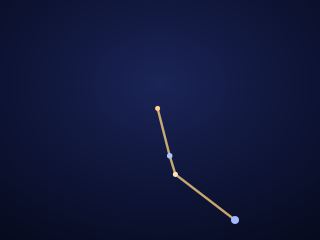 Pyxis
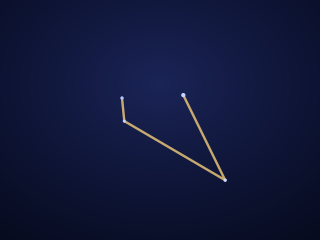 Sextans
 Virgo