Horologium
Pendulum Clock
Horologium (Pendulum Clock), a pendulum clock. A constellation of the southern sky; in the evening it is at its best in December. Its brightest star is α Horologii.
Working out its position…
1How to find it
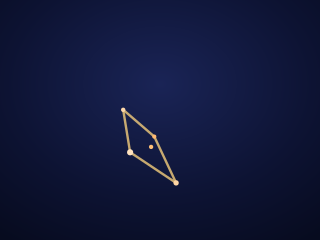
Horologium is a long, faint constellation of the southern sky, near Achernar at the end of Eridanus. It draws a line of faint stars, like the pendulum of a clock, running down towards the Large Magellanic Cloud. From mid-northern latitudes only its northern end grazes the horizon in December; it is really seen from the southern hemisphere.
2The main stars
| Star | Name | Magnitude | Distance | Type |
|---|---|---|---|---|
| α Horologii | — | 3.85 | 115 ly | K1III · orange giant |
| δ Horologii | — | 4.93 | 179 ly | A9V · white, main sequence |
| β Horologii | — | 4.98 | 295 ly | A5III · white giant |
| μ Horologii | — | 5.12 | 142 ly | F0IV · yellow-white subgiant |
| ζ Horologii | — | 5.21 | 160 ly | F4IV · yellow-white subgiant |
| ν Horologii | — | 5.25 | 165 ly | A2V · white, main sequence |
| η Horologii | — | 5.30 | 149 ly | A6V · white, main sequence |
| HR 1364 | — | 5.33 | 252 ly | K2III · orange giant |
| λ Horologii | — | 5.36 | 161 ly | F2III · yellow-white giant |
| ι Horologii | — | 5.40 | 56 ly | G3IV · yellow subgiant |
The smaller the magnitude, the brighter the star. Distances come from the Hipparcos satellite; beyond a few hundred light-years they are approximate.
3Myth and origin of the name
Lacaille named it “the Pendulum Clock with seconds”, in honour of the invention of the Dutchman Christiaan Huygens, who in 1656 had the idea of regulating a clock with the swings of a pendulum. Such clocks were at last accurate enough to mark the seconds.
For astronomers it was a revolution: to measure a star’s position, you note the exact moment it crosses the meridian. Without an accurate clock, there is no accurate star map. Lacaille thus placed in the sky the essential tool of his nights of work.
4History
The French astronomer Nicolas-Louis de Lacaille created it after charting nearly 10,000 southern stars from the Cape of Good Hope in 1751 and 1752. Like his thirteen other constellations, it honours an instrument of the sciences or the arts; it appears on his planisphere of 1756.
Its brightest star, Alpha, only reaches magnitude 3.9. It contains the globular cluster NGC 1261 and many distant galaxies.
Its present boundaries were drawn by the Belgian astronomer Eugène Delporte and adopted by the International Astronomical Union in 1930, like those of the other 87 constellations.
5Notable objects
6When to observe it
It is fully visible from every latitude south of 23° N. From mid-northern latitudes such as France (46° N), only its northern part rises above the southern horizon; to see all of it you need to be south of latitude 23° N. In the evening around 10 pm, it is highest in the sky in December (seen from mid-northern latitudes).
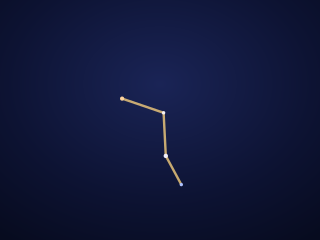 Caelum
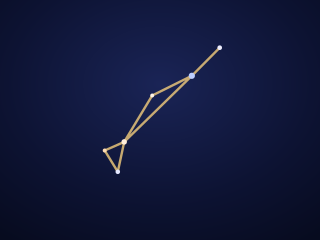 Dorado
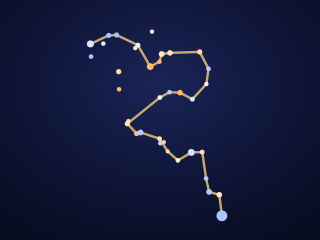 Eridanus
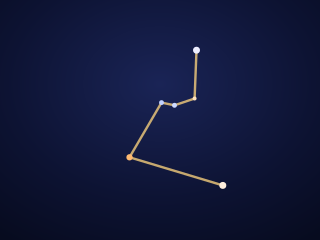 Hydrus
 Reticulum