Caelum
Chisel
Caelum (Chisel), an engraver’s chisel. A constellation of the southern sky; in the evening it is at its best in January. Its brightest star is α Caeli.
Working out its position…
1How to find it
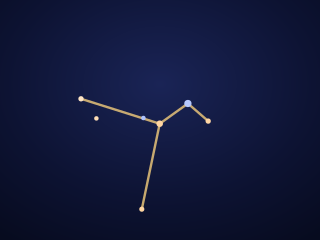
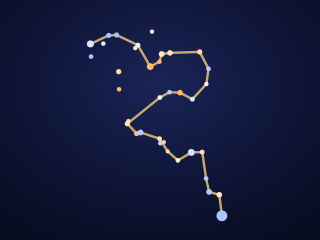
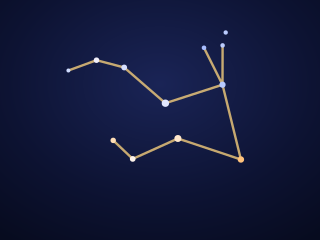
Caelum is one of the faintest constellations in the sky: four stars of magnitude 4 to 5 lined up between Columba and the river Eridanus. Find Rigel, at Orion’s foot, then Columba below Lepus: Caelum lies west of Columba. From mid-northern latitudes only its northern part rises, very low in the south on clear January evenings.
2The main stars
| Star | Name | Magnitude | Distance | Type |
|---|---|---|---|---|
| α Caeli | — | 4.44 | 66 ly | F2V · yellow-white, main sequence |
| γ¹ Caeli | — | 4.55 | 181 ly | K2III · orange giant |
| β Caeli | — | 5.04 | 94 ly | F3V · yellow-white, main sequence |
| δ Caeli | — | 5.07 | 704 ly | B2IV · blue-white subgiant |
| HR 1509 | — | 5.66 | 642 ly | K3III · orange giant |
| HR 1559 | — | 5.82 | 268 ly | A2 · white, main sequence |
| HR 1635 | — | 5.92 | 312 ly | K2III · orange giant |
| HR 1631 | — | 6.02 | 365 ly | G8III · yellow giant |
| HR 1526 | — | 6.04 | 317 ly | K1III · orange giant |
| HR 1557 | — | 6.06 | 171 ly | F1III · yellow-white giant |
The smaller the magnitude, the brighter the star. Distances come from the Hipparcos satellite; beyond a few hundred light-years they are approximate.
3Myth and origin of the name
Caelum has no legend: it is a tool. Lacaille had named it “the Engraver’s Chisels”, two steel gravers crossed and tied with a ribbon. The burin is the pointed tool used to engrave copper plates for printing pictures… and star charts.
In Lacaille’s time celestial atlases were indeed engraved with a burin on copper plates. By placing this tool in the sky, the astronomer paid tribute to the craftsmen who made it possible to share the sky with the whole world.
4History
The French astronomer Nicolas-Louis de Lacaille created it after charting nearly 10,000 southern stars from the Cape of Good Hope in 1751 and 1752. Like his thirteen other constellations, it honours an instrument of the sciences or the arts; it appears on his planisphere of 1756.
Its stars have remained very modest: the brightest, Alpha, only reaches magnitude 4.4.
Its present boundaries were drawn by the Belgian astronomer Eugène Delporte and adopted by the International Astronomical Union in 1930, like those of the other 87 constellations.
5Notable objects
No deep-sky object here is easy to see with small instruments: this is a region to explore with a telescope and a detailed chart.
6When to observe it
It is fully visible from every latitude south of 41° N. From mid-northern latitudes such as France (46° N), only its northern part rises above the southern horizon; to see all of it you need to be south of latitude 41° N. In the evening around 10 pm, it is highest in the sky in January (seen from mid-northern latitudes).
 Columba
 Dorado
 Eridanus
 Horologium
 Lepus
 Pictor