Lepus
Hare
Lepus (Hare), a hare. A constellation of the southern sky; in the evening it is at its best in January. Its brightest star is Arneb.
Working out its position…
1How to find it
Lepus lies right below Orion’s feet, south of Rigel and Saiph. Its main stars, Arneb and Nihal, of magnitude 2.6 and 2.8, form with a few others a small bow tie or the body of a crouching rabbit. It is well placed on January and February evenings, fairly low in the south from mid-northern latitudes.
2The main stars
| Star | Name | Magnitude | Distance | Type |
|---|---|---|---|---|
| α Leporis | Arneb | 2.58 | 2,219 ly | F0Ib · yellow-white supergiant |
| β Leporis | Nihal | 2.81 | 160 ly | G5II · yellow giant |
| ε Leporis | — | 3.19 | 213 ly | K4III · orange giant |
| μ Leporis | — | 3.29 | 186 ly | B9IV · blue-white subgiant |
| ζ Leporis | — | 3.55 | 70 ly | A2V · white, main sequence |
| γ Leporis | — | 3.59 | 29 ly | F7V · yellow-white, main sequence |
| η Leporis | — | 3.71 | 48 ly | F1V · yellow-white, main sequence |
| δ Leporis | — | 3.76 | 114 ly | G8III · yellow giant |
| λ Leporis | — | 4.29 | 852 ly | B0.5IV · blue-white subgiant |
| κ Leporis | — | 4.36 | 728 ly | B7V · blue-white, main sequence |
The smaller the magnitude, the brighter the star. Distances come from the Hipparcos satellite; beyond a few hundred light-years they are approximate.
3Myth and origin of the name
Lepus is the quarry of Orion the hunter, chased for ever by his two dogs, Canis Major and Canis Minor. Hares were said to be Orion’s favourite game.
Another legend told by the Greeks says that someone on the island of Leros brought in a pair of hares. Everyone wanted to raise them, so the animals multiplied and devoured all the crops. The islanders had to band together to hunt them, and the image of the hare was set in the sky as a reminder that you can have too much of a good thing.
4History
It is one of the 48 constellations described by Claudius Ptolemy around AD 150 in the Almagest, the great treatise of Greek astronomy that remained the reference for more than a thousand years.
In 1845 the Englishman John Russell Hind noticed an intensely red star in Lepus: R Leporis, nicknamed “Hind’s Crimson Star”. It is a carbon star that varies in brightness over about 14 months.
Its present boundaries were drawn by the Belgian astronomer Eugène Delporte and adopted by the International Astronomical Union in 1930, like those of the other 87 constellations.
5Notable objects
6When to observe it
It is fully visible from every latitude south of 63° N. In the evening around 10 pm, it is highest in the sky in January (seen from mid-northern latitudes).
 Canis Major
 Caelum
 Columba
 Eridanus
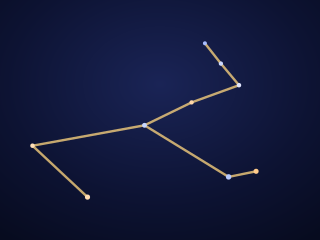 Monoceros
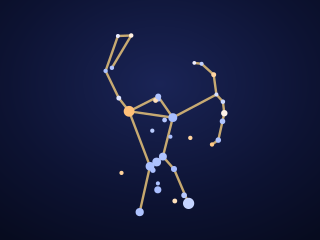 Orion