Columba
Dove
Columba (Dove), a dove. A constellation of the southern sky; in the evening it is at its best in January. Its brightest star is Phact.
Working out its position…
1How to find it
Columba lies south of Lepus, which is itself below Orion’s feet. On January and February evenings, look low on the southern horizon below Rigel: two stars of magnitude 2.6 and 3.1, Phact and Wazn, form the bird’s body, with a few fainter stars. From mid-northern latitudes it stays low but can be seen entirely on a clear night.
2The main stars
| Star | Name | Magnitude | Distance | Type |
|---|---|---|---|---|
| α Columbae | Phact | 2.65 | 261 ly | B7IV · blue-white subgiant |
| β Columbae | Wazn | 3.12 | 87 ly | K1.5III · orange giant |
| δ Columbae | — | 3.85 | 234 ly | G7II · yellow giant |
| ε Columbae | — | 3.86 | 263 ly | K1II · orange giant |
| η Columbae | — | 3.96 | 472 ly | K0III · orange giant |
| γ Columbae | — | 4.36 | 870 ly | B2.5IV · blue-white subgiant |
| κ Columbae | — | 4.37 | 182 ly | G8II · yellow giant |
| ο Columbae | — | 4.81 | 106 ly | K0 · orange giant |
| λ Columbae | — | 4.88 | 334 ly | B5V · blue-white, main sequence |
| ξ Columbae | — | 4.97 | 333 ly | K1III · orange giant |
The smaller the magnitude, the brighter the star. Distances come from the Hipparcos satellite; beyond a few hundred light-years they are approximate.
3Myth and origin of the name
Petrus Plancius intended it as Noah’s dove, which came back to the ark with an olive branch in its beak, a sign that land had reappeared after the Flood. Old charts often draw it with its olive twig.
Lovers of Greek myth sometimes see another dove: the one Jason and the Argonauts released in front of the Symplegades, two rocks that clashed together at the entrance to the Black Sea. The bird got through, losing only a few tail feathers, and the ship Argo, close by in the sky, was able to follow.
4History
It was introduced by the Dutch theologian and cartographer Petrus Plancius, who filled areas of the sky left empty by the ancients.
Plancius introduced it in 1592, using stars that Ptolemy had left outside the figures south of Canis Major. The star Mu Columbae is a “runaway star”: it seems to have been thrown out of the Orion region about 2.5 million years ago, together with another star racing in the opposite direction, AE Aurigae.
Its present boundaries were drawn by the Belgian astronomer Eugène Delporte and adopted by the International Astronomical Union in 1930, like those of the other 87 constellations.
5Notable objects
6When to observe it
It is fully visible from every latitude south of 47° N. In the evening around 10 pm, it is highest in the sky in January (seen from mid-northern latitudes).
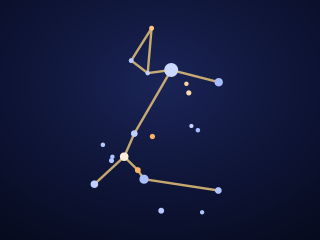 Canis Major
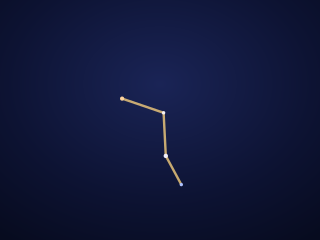 Caelum
 Lepus
 Pictor
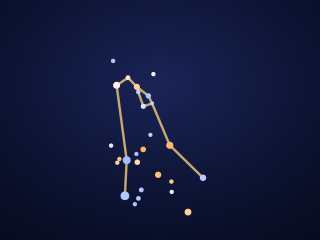 Puppis