Circinus
Compasses
Circinus (Compasses), a pair of compasses. A constellation of the southern sky; in the evening it is at its best in June. Its brightest star is α Circini.
Working out its position…
1How to find it
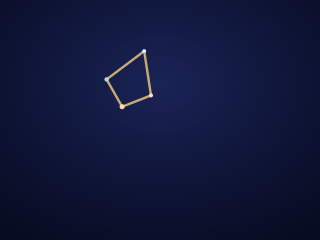
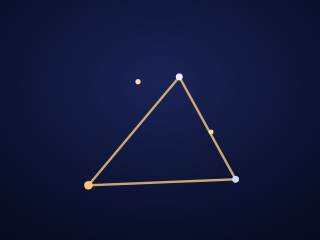
Circinus is a tiny southern constellation squeezed between Alpha Centauri and Triangulum Australe. From the southern hemisphere, find dazzling Alpha Centauri: Circinus lies right beside it to the south-east, as a narrow, elongated triangle of three stars, like the two legs of an open pair of compasses. It is not visible from Europe or North America.
2The main stars
| Star | Name | Magnitude | Distance | Type |
|---|---|---|---|---|
| α Circini | — | 3.18 | 54 ly | F1V · yellow-white, main sequence |
| β Circini | — | 4.07 | 100 ly | A3V · white, main sequence |
| γ Circini | — | 4.48 | 449 ly | B5III · blue-white giant |
| ε Circini | — | 4.85 | 408 ly | K2.5III · orange giant |
| δ Circini | — | 5.04 | — | O8.5V · blue, main sequence |
| θ Circini | — | 5.08 (variable 4.9–5.2) | 1,510 ly | B4V · blue-white, main sequence |
| η Circini | — | 5.16 | 276 ly | G8III · yellow giant |
| HR 5546 | — | 5.18 | 161 ly | K1III · orange giant |
| HR 5482 | — | 5.36 | 158 ly | A7V · white, main sequence |
| HR 5680 | — | 5.43 | — | O7Ia · blue supergiant |
The smaller the magnitude, the brighter the star. Distances come from the Hipparcos satellite; beyond a few hundred light-years they are approximate.
3Myth and origin of the name
Circinus has no legend: it is the draughtsman’s tool, used to draw circles and transfer measurements onto maps. Lacaille placed it beside Norma (the set square) and not far from Triangulum Australe, as if on the table of a surveyor or an architect.
For an 18th-century astronomer who spent his nights measuring angles and his days drawing charts, the compasses were a constant companion. Lacaille wanted to honour the patient work that made it possible to map the southern sky.
4History
The French astronomer Nicolas-Louis de Lacaille created it after charting nearly 10,000 southern stars from the Cape of Good Hope in 1751 and 1752. Like his thirteen other constellations, it honours an instrument of the sciences or the arts; it appears on his planisphere of 1756.
In 1977 a nearby galaxy was discovered here that had long gone unnoticed because it lies behind the Milky Way: the Circinus Galaxy, about 13 million light-years away.
Its present boundaries were drawn by the Belgian astronomer Eugène Delporte and adopted by the International Astronomical Union in 1930, like those of the other 87 constellations.
5Notable objects
6When to observe it
It is fully visible from every latitude south of 19° N. It is never visible from mid-northern latitudes such as France (46° N): you have to travel south of about 19° N to see all of it. In the evening around 10 pm, it is highest in the sky in June (seen from mid-southern latitudes).
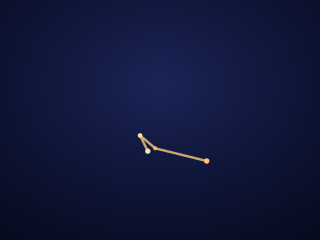 Apus
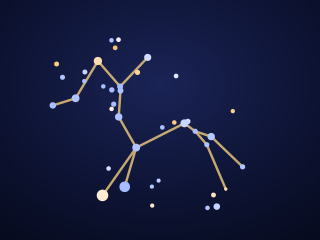 Centaurus
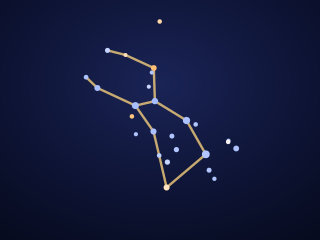 Lupus
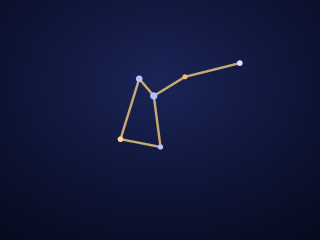 Musca
 Norma
 Triangulum Australe