Musca
Fly
Musca (Fly), a fly. A constellation of the southern sky; in the evening it is at its best in April. Its brightest star is α Muscae.
Working out its position…
1How to find it
Musca is a small southern constellation sitting just south of the Southern Cross, in the Milky Way. Its stars of magnitude 2.7 to 4 form a small, compact group that is easy to find: from the southern hemisphere, extend the long bar of the cross southwards, from Gacrux through Acrux and beyond; Musca is there. It is never visible from Europe or North America.
2The main stars
| Star | Name | Magnitude | Distance | Type |
|---|---|---|---|---|
| α Muscae | — | 2.69 | 315 ly | B2IV · blue-white subgiant |
| β Muscae | — | 3.04 | 342 ly | B2V · blue-white, main sequence |
| δ Muscae | — | 3.61 | 91 ly | K2III · orange giant |
| λ Muscae | — | 3.63 | 127 ly | A7III · white giant |
| γ Muscae | — | 3.84 | 325 ly | B5V · blue-white, main sequence |
| ε Muscae | — | 4.06 | 301 ly | M5III · red giant |
| μ Muscae | — | 4.75 | 430 ly | K4III · orange giant |
| η Muscae | — | 4.79 | 383 ly | B8V · blue-white, main sequence |
| HR 5002 | — | 4.86 | 1,195 ly | K2Ib · orange supergiant |
| HR 4549 | — | 4.89 | 362 ly | B4V · blue-white, main sequence |
The smaller the magnitude, the brighter the star. Distances come from the Hipparcos satellite; beyond a few hundred light-years they are approximate.
3Myth and origin of the name
The Dutch navigators first drew a bee here, Apis. Lacaille preferred a fly, and that is the name that stuck. It has sometimes been said that the fly is the prey of the neighbouring Chameleon, ready to snap it up with its tongue.
For a while the constellation was called the Southern Fly, to tell it apart from a Northern Fly, a small figure near Aries that has since vanished from the charts.
4History
It grew out of the observations of the Dutch navigators Pieter Dirkszoon Keyser and Frederick de Houtman during the first Dutch voyage to the East Indies (1595–1597). The cartographer Petrus Plancius placed it on a celestial globe in 1598, and Johann Bayer included it in his atlas Uranometria in 1603.
Musca contains two globular clusters, NGC 4833 and NGC 4372, and part of the dark Coalsack Nebula, which spills over from the Southern Cross.
Its present boundaries were drawn by the Belgian astronomer Eugène Delporte and adopted by the International Astronomical Union in 1930, like those of the other 87 constellations.
5Notable objects
6When to observe it
It is fully visible from every latitude south of 14° N. It is never visible from mid-northern latitudes such as France (46° N): you have to travel south of about 14° N to see all of it. In the evening around 10 pm, it is highest in the sky in April (seen from mid-southern latitudes).
 Apus
 Carina
 Centaurus
 Chamaeleon
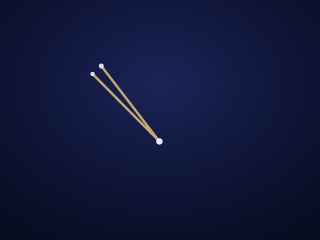 Circinus
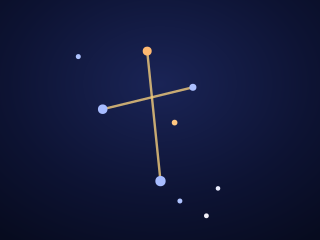 Crux