Crux
Southern Cross
Crux (Southern Cross), a cross. A constellation of the southern sky; in the evening it is at its best in April. Its brightest star is Acrux.
Working out its position…
1How to find it
The Southern Cross is the smallest of the 88 constellations, but one of the most famous. Four bright stars make a slightly lopsided cross; a fifth, fainter one sits between the arms. From the southern hemisphere it is easy to find thanks to the two “Pointers”, Alpha and Beta Centauri, lined up next to it. Extend the long bar of the cross, from Gacrux towards Acrux, by about four and a half times its length: you reach the neighbourhood of the south celestial pole. It cannot be seen from Europe; you need to be south of about latitude 25° N to see all of it.
2The main stars
| Star | Name | Magnitude | Distance | Type |
|---|---|---|---|---|
| α¹ Crucis | Acrux | 0.77 | 322 ly | B0.5IV · blue-white subgiant |
| β Crucis | Mimosa | 1.25 | 278 ly | B0.5III · blue-white giant |
| γ Crucis | Gacrux | 1.59 | 89 ly | M4III · red giant |
| δ Crucis | Imai | 2.79 | 345 ly | B2IV · blue-white subgiant |
| ε Crucis | Ginan | 3.59 | 230 ly | K3 · orange giant |
| μ¹ Crucis | — | 4.03 | 414 ly | B2IV · blue-white subgiant |
| ζ Crucis | — | 4.06 | 358 ly | B2.5V · blue-white, main sequence |
| η Crucis | — | 4.14 | 64 ly | F2III · yellow-white giant |
| θ¹ Crucis | — | 4.32 | 235 ly | A · white |
| HR 4848 | — | 4.62 | 385 ly | B3V · blue-white, main sequence |
The smaller the magnitude, the brighter the star. Distances come from the Hipparcos satellite; beyond a few hundred light-years they are approximate.
3Myth and origin of the name
The Greeks did not know the Southern Cross as a separate figure: Ptolemy counted its stars as part of the Centaur’s legs. In his time, because of precession, they could actually be seen from Alexandria and the eastern Mediterranean; since then they have slowly sunk below the European horizon.
For many peoples of the southern hemisphere these stars tell other stories. Aboriginal Australians see, depending on the region, a tree, an emu’s foot or the head of the Emu in the Sky, whose body is traced by the dark clouds of the Milky Way. For the Māori it is the anchor of the great celestial canoe. Today the Southern Cross appears on the flags of Australia, New Zealand, Brazil, Samoa and Papua New Guinea.
4History
European navigators of the 15th and 16th centuries, sailing down the coast of Africa, noticed this bright cross; in 1516 the Florentine traveller Andrea Corsali described it as “a marvellous cross”. It appears as a separate constellation on globes of the late 16th century and became established in the 17th century. The Coalsack, a dark nebula visible to the naked eye, and the Jewel Box, a cluster of coloured stars named by John Herschel, lie next to Mimosa.
Its present boundaries were drawn by the Belgian astronomer Eugène Delporte and adopted by the International Astronomical Union in 1930, like those of the other 87 constellations.
5Notable objects
6When to observe it
It is fully visible from every latitude south of 25° N. It is never visible from mid-northern latitudes such as France (46° N): you have to travel south of about 25° N to see all of it. In the evening around 10 pm, it is highest in the sky in April (seen from mid-southern latitudes).
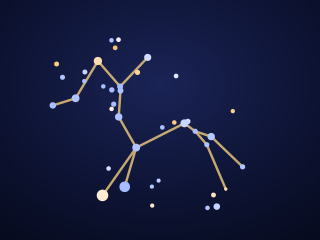 Centaurus
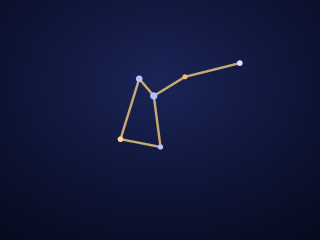 Musca