Centaurus
Centaur
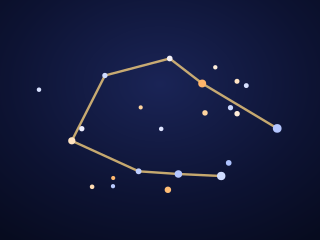
Centaurus (Centaur), a centaur, half man and half horse. A constellation of the southern sky; in the evening it is at its best in May. Its brightest star is Rigil Kentaurus.
Working out its position…
1How to find it
Centaurus is one of the largest and richest constellations of the southern sky. It wraps around the Southern Cross on three sides. Its two jewels, Alpha (Rigil Kentaurus) and Beta (Hadar), form a bright pair known as “the Pointers”: the line joining them leads straight to the Southern Cross. From mid-northern latitudes only the northern part of Centaurus grazes the southern horizon in spring; its two star attractions stay out of sight.
2The main stars
| Star | Name | Magnitude | Distance | Type |
|---|---|---|---|---|
| α¹ Centauri | Rigil Kentaurus | -0.01 | 4 ly | G2V · yellow, main sequence |
| β Centauri | Hadar | 0.61 | 392 ly | B1III · blue-white giant |
| α² Centauri | Toliman | 1.35 | 4 ly | K1V · orange, main sequence |
| θ Centauri | Menkent | 2.06 | 59 ly | K0III · orange supergiant |
| γ Centauri | — | 2.20 | 130 ly | A1IV · white subgiant |
| ε Centauri | — | 2.29 | 428 ly | B1III · blue-white giant |
| η Centauri | — | 2.33 | 306 ly | B1V · blue-white, main sequence |
| ζ Centauri | — | 2.55 | 382 ly | B2.5IV · blue-white subgiant |
| δ Centauri | — | 2.58 | 415 ly | B2IV · blue-white subgiant |
| ι Centauri | — | 2.75 | 59 ly | A2V · white, main sequence |
The smaller the magnitude, the brighter the star. Distances come from the Hipparcos satellite; beyond a few hundred light-years they are approximate.
3Myth and origin of the name
Centaurus is often identified with Chiron, the wisest of the centaurs. Unlike his kind, who were known to be brutal, he knew medicine, music, hunting and the stars, and he taught many heroes: Achilles, Jason, Asclepius.
One day Heracles wounded him by accident with an arrow dipped in the Hydra’s venom. Chiron, being immortal, could neither heal nor die. He chose to give up his immortality, and Zeus, remembering his kindness, placed him among the stars.
4History
It is one of the 48 constellations described by Claudius Ptolemy around AD 150 in the Almagest, the great treatise of Greek astronomy that remained the reference for more than a thousand years.
Ptolemy, observing from Alexandria, could still see almost all of Centaurus, and even the Southern Cross, which he counted as part of the centaur’s legs. He also listed a fuzzy “star” that is really Omega Centauri, the largest globular cluster in our galaxy. In 1915 the Scot Robert Innes discovered, next to Alpha Centauri, a small red star invisible to the naked eye: Proxima Centauri, the nearest star to the Sun, 4.2 light-years away.
Its present boundaries were drawn by the Belgian astronomer Eugène Delporte and adopted by the International Astronomical Union in 1930, like those of the other 87 constellations.
5Notable objects
6When to observe it
It is fully visible from every latitude south of 25° N. From mid-northern latitudes such as France (46° N), only its northern part rises above the southern horizon; to see all of it you need to be south of latitude 25° N. In the evening around 10 pm, it is highest in the sky in May (seen from mid-northern latitudes).
 Antlia
 Carina
 Circinus
 Crux
 Hydra
 Lupus
 Musca
 Vela