CarteduCiel.eu
FR

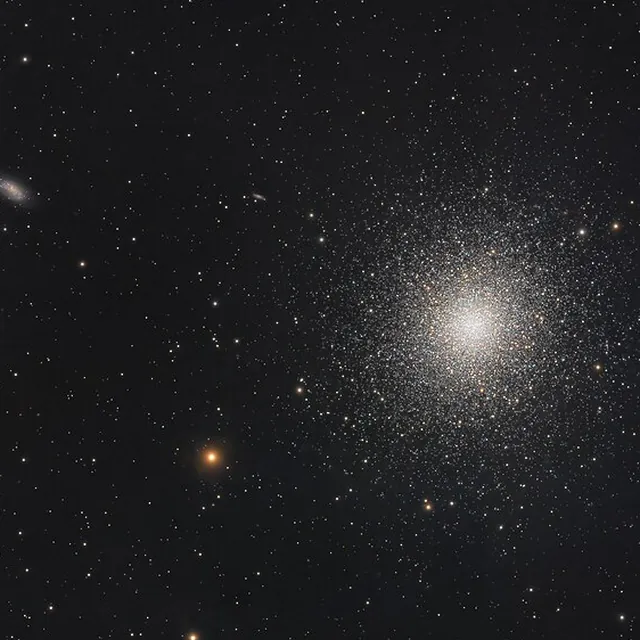
Omega Centauri

Giant globular cluster

≈ 17,000 light-years away, in the constellation Centaurus. Naked eye, under a dark sky.
CentaurusNGC 5139
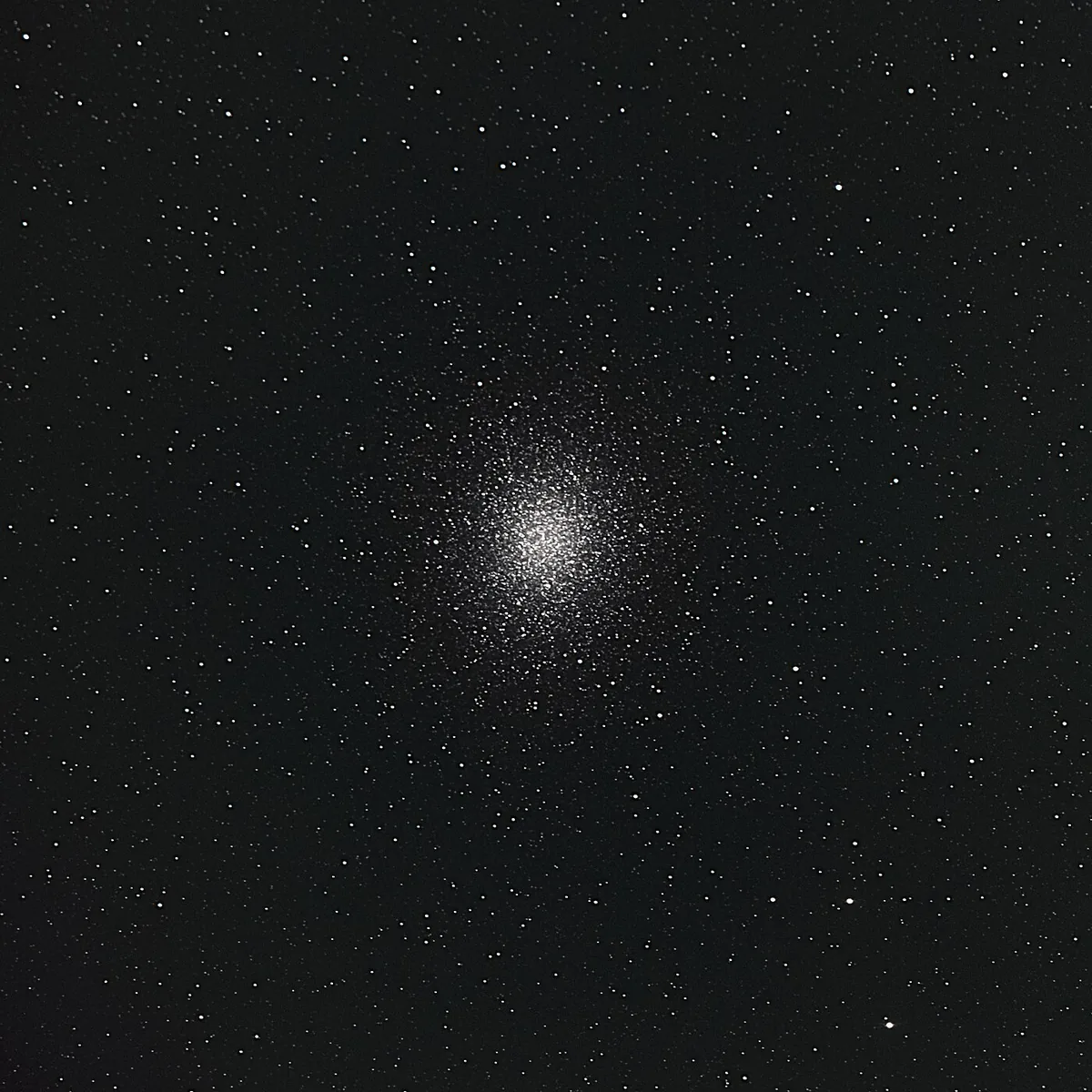
Photograph: Omega Centauri
Photo: Stephen Rahn · licence CC0 · Wikimedia Commons · cropped and resized

1Overview

Omega Centauri (NGC 5139) is the largest and brightest globular cluster in our galaxy. To the naked eye, from the southern hemisphere, it looks like a fuzzy star, so much so that Ptolemy listed it as a star; that is why it bears a Greek letter. In binoculars it is a glowing ball wider than the full Moon.

It gathers about ten million stars over some 150 light-years, about 17,000 light-years from us. Its stars do not all have the same age or composition, which is unusual: Omega Centauri may be the core of a small galaxy swallowed by the Milky Way. In 2024 a study of very fast stars at its centre revealed the probable presence of an intermediate-mass black hole. It cannot be seen from Europe.

2How to find it

NGC 5139 · magnitude 4.58 · magnitude 4.52 · magnitude 4.52 · magnitude 4.47 · magnitude 4.46 · magnitude 4.41χ Cen · magnitude 4.36υ² Cen · magnitude 4.34 · magnitude 4.333 Cen · magnitude 4.32 · magnitude 4.30 · magnitude 4.30ξ² Cen · magnitude 4.27 · magnitude 4.251 Cen · magnitude 4.232 Cen · magnitude 4.19 · magnitude 4.11 · magnitude 4.06ψ Cen · magnitude 4.05 · magnitude 4.01ρ Cen · magnitude 3.97σ Cen · magnitude 3.91 · magnitude 3.90π Cen · magnitude 3.90υ¹ Cen · magnitude 3.87τ Cen · magnitude 3.85φ Cen · magnitude 3.83μ Cen · magnitude 3.47ν Cen · magnitude 3.41κ Cen · magnitude 3.13λ Cen · magnitude 3.11ι Cen · magnitude 2.75δ Cen · magnitude 2.58ζ Cen · magnitude 2.55η Cen · magnitude 2.33ε Cen · magnitude 2.29γ Cen · magnitude 2.20Menkent, θ Cen · magnitude 2.06Toliman, α² Cen · magnitude 1.35Hadar, β Cen · magnitude 0.61Rigil Kentaurus, α¹ Cen · magnitude -0.01NGC 5139Rigil KentaurusHadarMenkentγεηζδιλκνφτυ¹πσρψξ²χCIRCINUSCRUXLUPUSNWES

Finder chart drawn by CarteDuCiel.eu: the object is circled in orange. North up, east left.

Where to see it tonight?
Working it out…

3When to observe it

This object never rises from mid-northern latitudes such as France: you have to travel south of latitude 43° N to see it. In the southern hemisphere it is best placed in the evening in May.
0°30°60°90°JanFebMarAprMayJunJulAugSepOctNovDecMid-northern (46° N) · January : -48°Mid-northern (46° N) · February : -30°Mid-northern (46° N) · March : -17°Mid-northern (46° N) · April : -7°Mid-northern (46° N) · May : -3°Mid-northern (46° N) · June : -8°Mid-northern (46° N) · July : -18°Mid-northern (46° N) · August : -33°Mid-northern (46° N) · September : -52°Mid-northern (46° N) · October : -71°Mid-northern (46° N) · November : -87°Mid-northern (46° N) · December : -68°Mid-southern (34° S) · January : 9°Mid-southern (34° S) · February : 27°Mid-southern (34° S) · March : 45°Mid-southern (34° S) · April : 65°Mid-southern (34° S) · May : 76°Mid-southern (34° S) · June : 62°Mid-southern (34° S) · July : 43°Mid-southern (34° S) · August : 23°Mid-southern (34° S) · September : 6°Mid-southern (34° S) · October : -5°Mid-southern (34° S) · November : -8°Mid-southern (34° S) · December : -3°Mid-northern (46° N)Mid-southern (34° S)horizon

4Also worth seeing