The Great Hercules Cluster
Globular cluster
≈ 22,000 light-years away, in the constellation Hercules. Binoculars.
1Overview
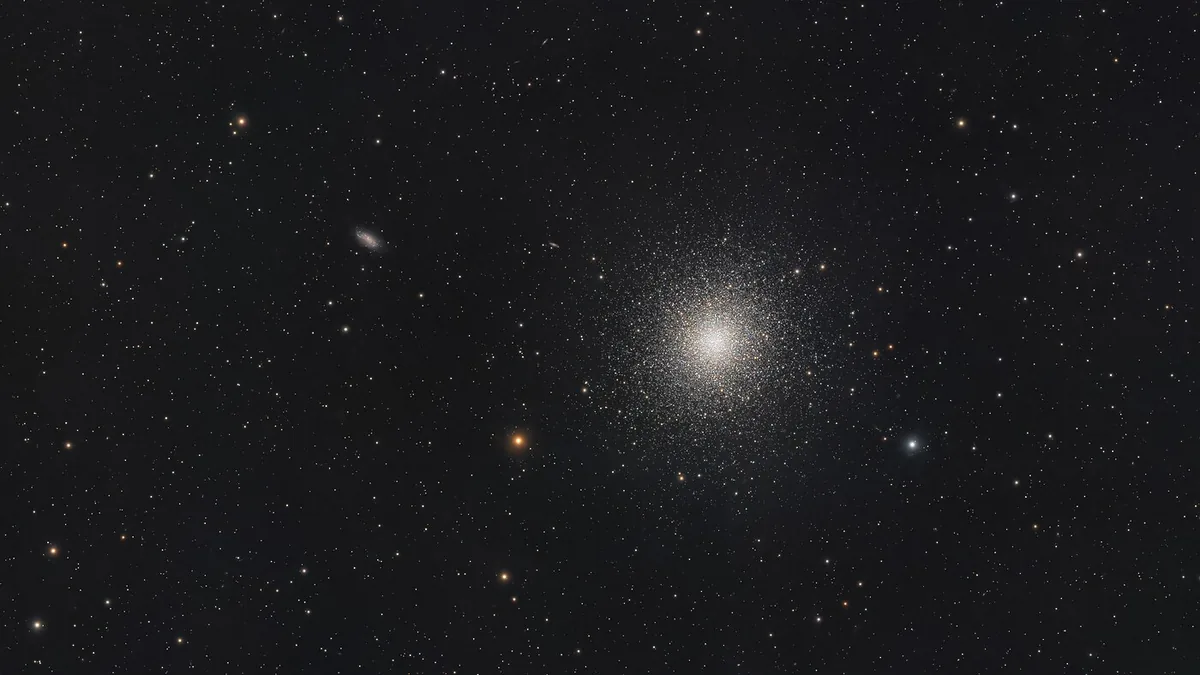
The Great Hercules Cluster (M13) is the finest globular cluster in the northern sky. In binoculars it appears as a small cottony ball on the western side of the “Keystone” of Hercules; in a telescope it resolves into thousands of twinkling stars.
This sphere of several hundred thousand stars, about 145 light-years across, lies some 22,000 light-years away. Its stars are very old, more than 11 billion years: they were born soon after our galaxy formed.
Edmond Halley discovered it in 1714. In 1974 the Arecibo radio telescope sent a coded message describing humanity towards it; it will take more than 20,000 years to arrive.
2How to find it
Finder chart drawn by CarteDuCiel.eu: the object is circled in orange. North up, east left.
Working it out…
3When to observe it
From mid-northern latitudes (46° N), the best time to observe it is in the evening in July, when it culminates 80° above the horizon. Choose a moonless night, away from lights.
 Omega Centauri
 47 Tucanae
 The Andromeda Galaxy
 The Orion Nebula