CarteduCiel.eu
FR

The Orion Nebula

Emission nebula and star nursery

≈ 1,350 light-years away, in the constellation Orion. Naked eye, under a dark sky.
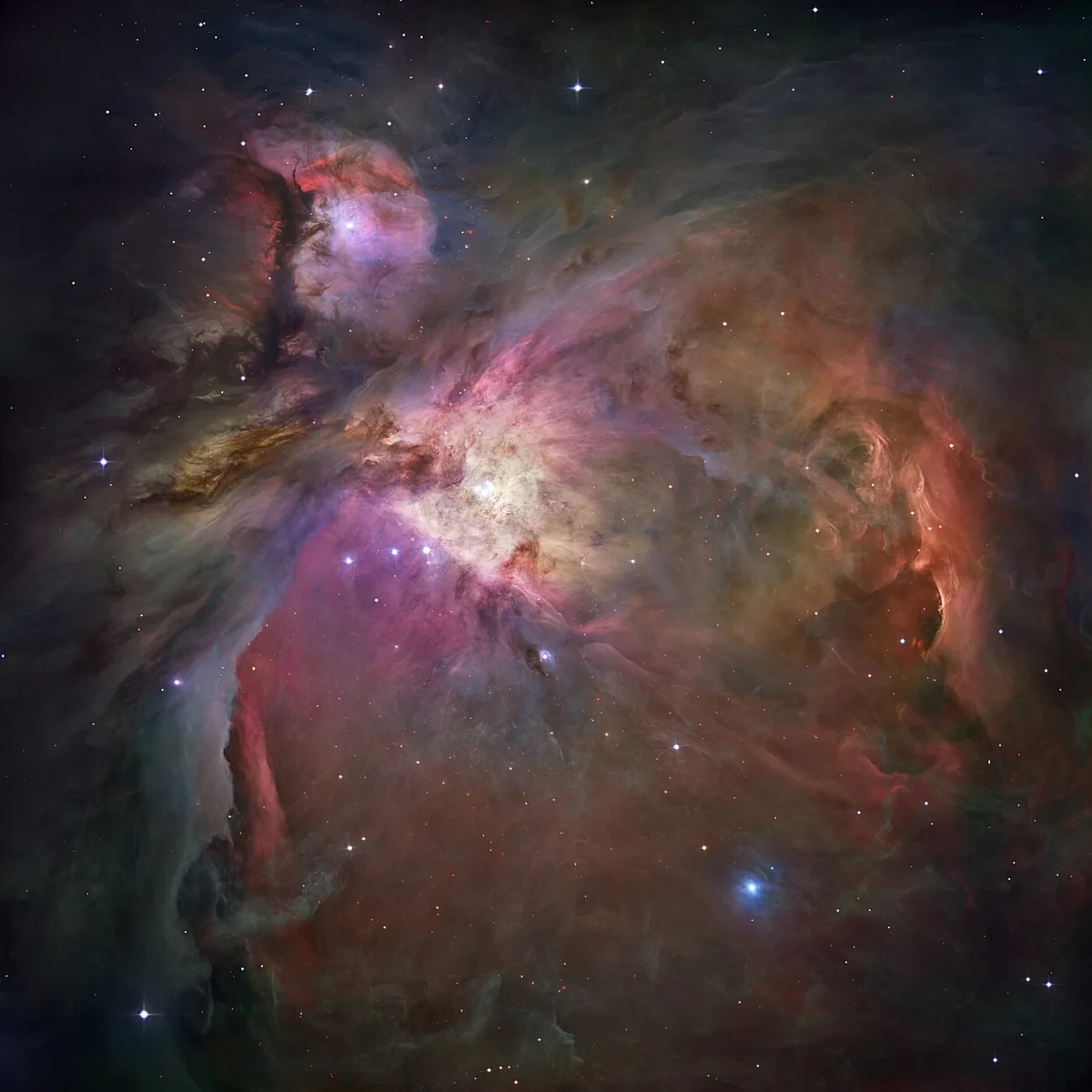
OrionM42NGC 1976
Photograph: The Orion Nebula
Photo: NASA, ESA, M. Robberto (STScI/ESA) and the Hubble Space Telescope Orion Treasury Project Team · public domain · Wikimedia Commons · cropped and resized

1Overview

The Orion Nebula (M42) is the most famous star nursery in the sky. With the naked eye, below the three stars of the Belt, you can notice that the middle “star” of Orion’s Sword is fuzzy: that is the nebula. In binoculars you already see a glowing fan-shaped cloud.

This cloud of gas and dust, about 1,350 light-years away, is nearly 25 light-years across. At its heart, four very hot young stars, the Trapezium, light it up and make its gas glow. The Hubble Space Telescope photographed dozens of discs of matter around newborn stars there: planetary systems in the making.

It was first described through a telescope in 1610 by Nicolas-Claude Fabri de Peiresc, an astronomer from Provence.

2How to find it

M42ψ² Ori · magnitude 4.5942 Ori · magnitude 4.58 · magnitude 4.53ω Ori · magnitude 4.50π⁶ Ori · magnitude 4.47ρ Ori · magnitude 4.46ξ Ori · magnitude 4.45ν Ori · magnitude 4.42χ¹ Ori · magnitude 4.39φ¹ Ori · magnitude 4.39π² Ori · magnitude 4.3532 Ori · magnitude 4.2029 Ori · magnitude 4.13μ Ori · magnitude 4.12φ² Ori · magnitude 4.09ο² Ori · magnitude 4.06σ Ori · magnitude 3.77π⁵ Ori · magnitude 3.71π⁴ Ori · magnitude 3.68τ Ori · magnitude 3.59Meissa, λ Ori · magnitude 3.39η Ori · magnitude 3.35Tabit, π³ Ori · magnitude 3.19Hatysa, ι Ori · magnitude 2.75Mintaka, δ Ori · magnitude 2.25Saiph, κ Ori · magnitude 2.07Alnitak, ζ Ori · magnitude 1.74Alnilam, ε Ori · magnitude 1.69Bellatrix, γ Ori · magnitude 1.64Betelgeuse, α Ori · magnitude 0.45Rigel, β Ori · magnitude 0.18M42RigelBetelgeuseBellatrixAlnilamSaiphMintakaιπ³ηλτπ⁴π⁵σο²μπ²χ¹νξρπ⁶ωψ²NWES

Finder chart drawn by CarteDuCiel.eu: the object is circled in orange. North up, east left.

Where to see it tonight?
Working it out…

3When to observe it

From mid-northern latitudes (46° N), the best time to observe it is in the evening in January, when it culminates 39° above the horizon. Choose a moonless night, away from lights.
0°30°60°90°JanFebMarAprMayJunJulAugSepOctNovDecMid-northern (46° N) · January : 39°Mid-northern (46° N) · February : 31°Mid-northern (46° N) · March : 16°Mid-northern (46° N) · April : -4°Mid-northern (46° N) · May : -24°Mid-northern (46° N) · June : -42°Mid-northern (46° N) · July : -49°Mid-northern (46° N) · August : -42°Mid-northern (46° N) · September : -24°Mid-northern (46° N) · October : -4°Mid-northern (46° N) · November : 17°Mid-northern (46° N) · December : 32°Mid-southern (34° S) · January : 61°Mid-southern (34° S) · February : 49°Mid-southern (34° S) · March : 28°Mid-southern (34° S) · April : 3°Mid-southern (34° S) · May : -21°Mid-southern (34° S) · June : -42°Mid-southern (34° S) · July : -51°Mid-southern (34° S) · August : -41°Mid-southern (34° S) · September : -20°Mid-southern (34° S) · October : 3°Mid-southern (34° S) · November : 28°Mid-southern (34° S) · December : 50°Mid-northern (46° N)Mid-southern (34° S)horizon

4Also worth seeing