The Pleiades
Open cluster
≈ 444 light-years away, in the constellation Taurus. Naked eye, under a dark sky.
1Overview
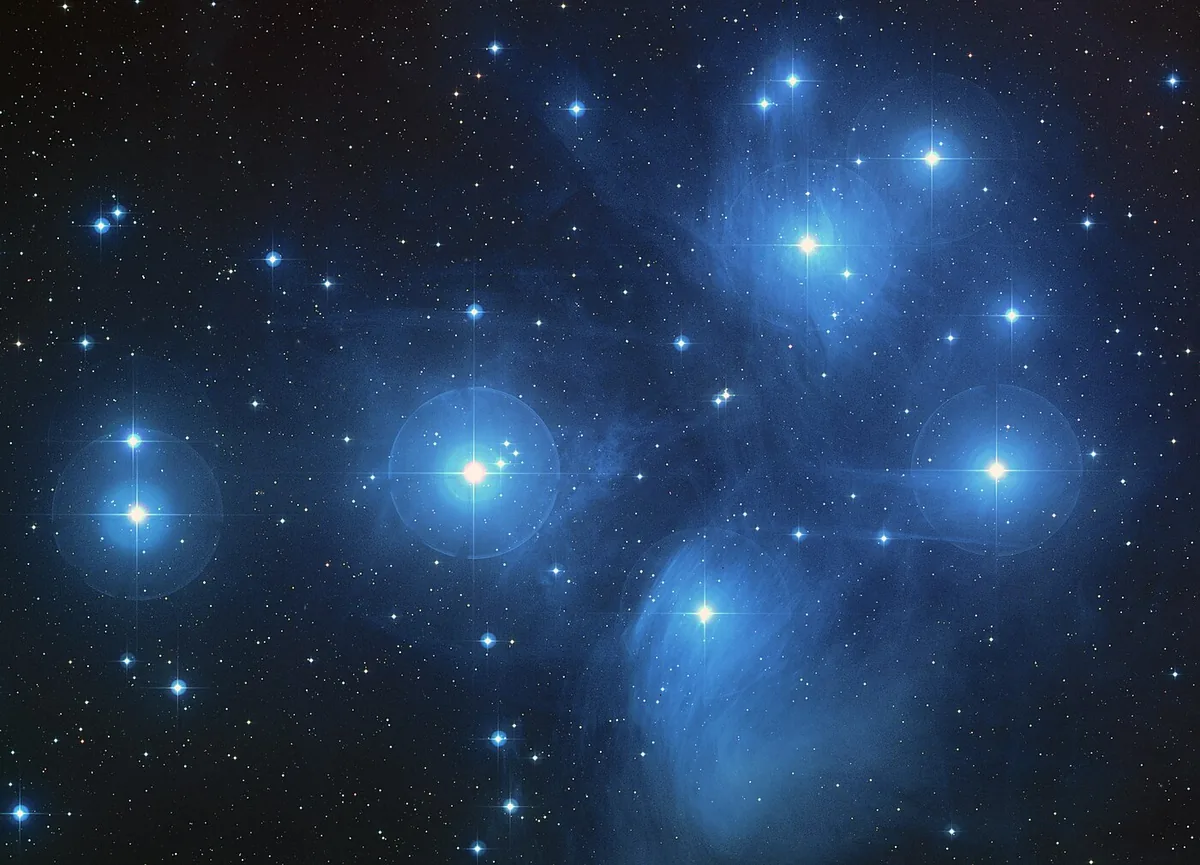
The Pleiades (M45) are the finest star cluster visible to the naked eye: a tight little group shaped like a tiny dipper, on the shoulder of Taurus. Six or seven can be seen with the naked eye, dozens in binoculars. The cluster actually contains more than a thousand stars, born together about 100 million years ago, some 440 light-years away.
In photographs the stars are bathed in a bluish haze: a cloud of dust that the cluster happens to be crossing, lit up by its stars.
The Pleiades are known to almost every culture. For the Greeks they were the seven daughters of Atlas; in Japan they are called Subaru; for the Māori of New Zealand, their reappearance at dawn, Matariki, marks the New Year. The Nebra sky disc, made in Germany about 3,600 years ago, may show the oldest known depiction of them.
2How to find it
Finder chart drawn by CarteDuCiel.eu: the object is circled in orange. North up, east left.
Working it out…
3When to observe it
From mid-northern latitudes (46° N), the best time to observe it is in the evening in December, when it culminates 68° above the horizon. Choose a moonless night, away from lights.
 The Crab Nebula
 The Hyades
 The Beehive Cluster
 The Double Cluster