The Double Cluster
Pair of open clusters
≈ 7,500 light-years away, in the constellation Perseus. Binoculars.
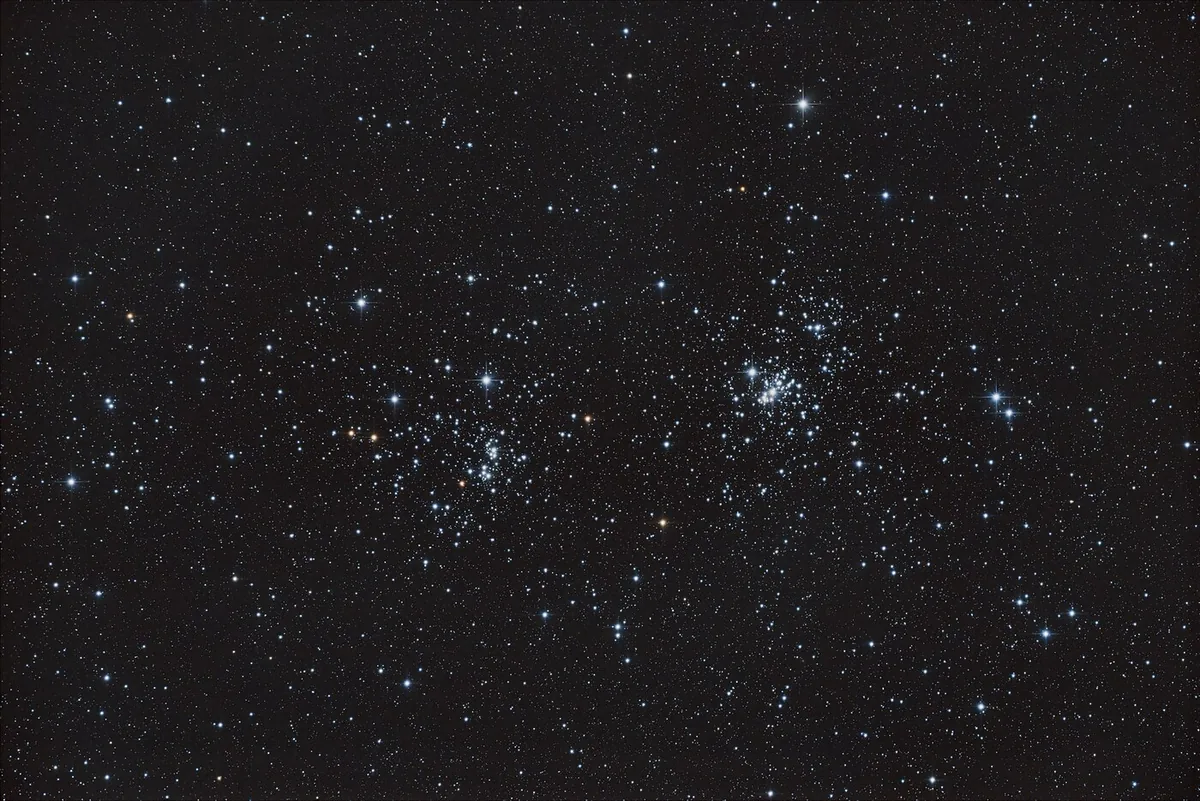
1Overview
The Double Cluster (h and chi Persei, NGC 869 and NGC 884) is a prime sight for binoculars: two swarms of stars side by side, between Perseus and Cassiopeia. To the naked eye, under a dark sky, you see a small elongated patch in the Milky Way; the Greek astronomer Hipparchus already mentioned it in the 2nd century BC.
The two clusters, about 7,500 light-years away, are very young: barely fifteen million years old. They contain many blue stars and a few red supergiants that dot the scene with orange points. From mid-northern latitudes they can be seen almost all year, best in autumn.
2How to find it
Finder chart drawn by CarteDuCiel.eu: the object is circled in orange. North up, east left.
Working it out…
3When to observe it
From mid-northern latitudes (46° N), the best time to observe it is in the evening in November, when it culminates 90° above the horizon. Choose a moonless night, away from lights.
 The Pleiades
 The Beehive Cluster
 The Hyades
 The Andromeda Galaxy